
By Felecia Piggott-Long, Ph.D.
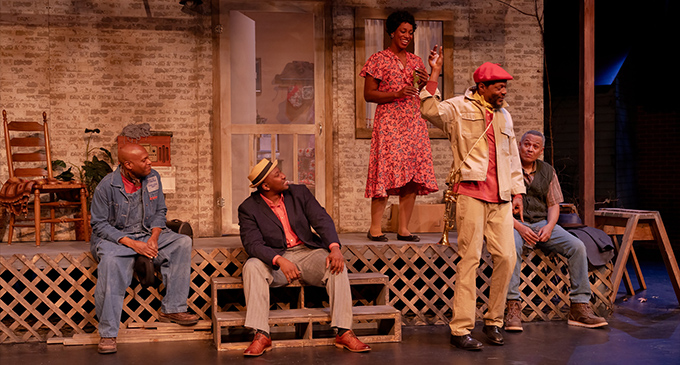
“Fences” by August Wilson opened on Friday, Feb. 28, at the Hanesbrands Theatre; it will close on March 16. The cast includes protagonist Troy Maxson (Jackie Alexander), a sanitation worker, an ex-con and former standout in the Negro Baseball League; his wife Rose Maxson (Mya Brown); their son Cory Maxson (Vonii Bristow); Troy’s mentally-challenged brother Gabriel Maxson (Hayden Crawford); Jim Bono (Andre Minkins); Troy’s best friend; Raynell Maxson (McKinley Pate or Imani Quoi); Troy’s extra-marital daughter with Alberta; and Lyons Maxson (Joe Johnson), Troy’s son from a previous relationship.
The set design was exceptional. The play is set in the Hill District of Pittsburgh, Pennsylvania, a community historically comprised of Black and working-class residents. The entire play takes place at the Maxson home around 1958. The Maxson home captures the traditional 1950’s clothesline replete with clothespins, family laundry on the line, a brick exterior which expresses the reach for the American Dream, gardening tools in the yard, storage house on the corner of the lot for surplus, a large tree designed as a hitting post for a baseball player, with a bat leaning against it. A white picket fence is being built around the yard.
The North Carolina Black Repertory Company, under the direction of founder and artistic director Larry Leon Hamlin, staged the first professional production of August Wilson’s play “Fences” in North Carolina in 1991 with the support of the Charlotte Repertory Company. The N.C. Black Rep proudly revives this timeless classic with another connection to Charlotte through the director of “Fences” Rory D. Sheriff, founder and artistic director of BNS Productions, the city’s only African American theatre company.
“Fences” was the third play by an African American to be awarded the Pulitzer Prize. August Wilson’s most widely known work won the Pulitzer Prize in 1987. In addition, it received the New York Drama Critics Circle Award and a Tony Award for best play. The play was developed at the Eugene O’Neill Theater in 1983 and produced at the Yale Repertory Theater in 1985. It opened on Broadway at the 46th Street Theater on March 26, 1987, featuring James Earl Jones as Troy and Mary Alice as Rose, according to “The Oxford Companion to African American Literature.”
The cast in Winston-Salem was strong and vigilant about carrying each conflict to the conclusion. “Fences” is a seminal work in Wilson’s ten-drama cycle covering the African American experience across the twentieth century. Set between 1957 and 1965, “Fences” champions the Civil Rights Movement, a push for social justice. The protagonist is in a fiery battle against racism, the culprit that stole his athletic career.
Protagonist Troy Maxson (Jackie Alexander) is a bitter, jaded man who refuses to accept that he came along too late to play baseball in the major leagues. How could a master home run hitter in the Negro Leagues have been looked over? Racism and white supremacy have kept him pinned to the experimental wax of science labs controlled by the masters of an evil, historical narrative that keeps Blacks in their places and whites in control.
Troy is also caught in a web of “dreams deferred” because for 18 years, he has not been able to rise above his meager pay as a garbage man. To purchase The American Dream, a home surrounded by the picket fence, Troy had to use unethical practices. He had to cash in on his brother Gabriel’s disability check from the war. Troy’s guilt causes him to blame his son from his present wife and his son from his previous relationship for his own failures. Jackie Alexander does an exceptional job of showing the audience how deferred dreams cause a Black man to “dry up like a raisin in the sun/ or fester like a sore and then run … or sag like a heavy load … or explode!” These lines come from “Harlem,” a poem by Langston Hughes.
Troy is also caught in an unfulfilling marriage to his wife Rose (Mya Brown). Troy is so blinded by his own entrapment, he cannot appreciate the value of his family, his salvation. Rose appears clueless to her plight of infidelity until Troy spills the beans about his extra-marital affair and its aftermath.
Rose retaliates with vim and vigor. Her spirit of vengeance pervades the entire family’s response. Although Rose is a strong, loving religious woman who provides the voice of reason in the family, once she discovers Troy’s infidelity, she expresses the lack of forgiveness of the Puritans, who have found no way to receive forgiveness nor to offer it. Brown is a woman of beauty who is statuesque with legs that stop traffic. Her ability to become the caregiver for her family is exceptional, as she is always eager to provide a wholesome meal.
Gabriel Maxson (Hayden Crawford) is Troy’s brother, but he believes that he is the archangel Gabriel. He believes that he is a saint who is working to chase the hellhounds away. He is the victim of a brain injury that resulted in his having to have a metal plate put into his head. He is a veteran of World War II, from Pittsburgh, Pennsylvania, and he carries baskets of fruits around to sell. His brain injury has caused a loss of cognitive abilities, and Crawford displays this loss of brain function in a believable way.
Troy conflicts with his own abusive father who is now deceased, with his young son Cory (Vonii Bristow), with his older son Lyons (Joe Johnson), and with his daughter Raynell (McKinley Pate and Imani Quoi) who only remembers her father’s song about a dog named Blue.
Because Troy believes that racism crippled his own career in athletics, he refuses to allow his son Cory to play on the football team. Troy butchers Cory’s dream of success and drives Cory away with his abuse. Troy also bitterly criticizes his son Lyons who chooses to be a musician. Troy wants to control and micro-manage everyone’s dreams because he lost control of his own dreams.
Jim Bono (Andre Minkins) has been a loyal friend to Troy since they met in prison. They now work together as garbage men for the sanitation department. Minkins has an uncanny way of showing his appreciation for Troy’s wisdom and strong work ethic. He finds ways to remind Troy that he needs to hold on to his wife’s faith and continue to build a fence around his family structure. Because they constantly banter ideas between one another, they are evidence that iron sharpens iron in a relationship of equals. Bono rises as the victor in the love department. Bono admired the sensible choices Troy made until he became entangled with Alberta.
Some people build fences to keep people in and others build fences to keep some elements outside. Troy’s line as he speaks to death is “I’m gonna build me a fence around what belongs to me. And then I want you to stay on the other side. You stay over there till you’re ready for me, then you come on.”
One major theme in the play is the separation from the father because of abuse. The father-son relationships in the play are problematized. Throughout the play, the audience is on an emotional roller coaster that creates distinctive highs and lows. Come on and ride the mighty high! (Mighty Clouds of Joy).