
By Judie Holcomb-Pack
The Chronicle
People who are 65 years old today can expect to live an additional 19.3 years, on average, according to the Disease Control and Prevention (CDC). Jeanne Wei, MD, Ph.D., executive director of the Reynolds Institute on Aging at the University of Arkansas for Medical Sciences, says that along with making healthy lifestyle choices, to avoid senior health risks, “you need to be physically active and eat a healthy diet.” It sounds simple enough, but how many of us are taking that advice?
Older adults are at higher risk for chronic health problems like diabetes, osteoporosis and Alzheimer’s. In addition, one in four adults fall each year (a common question your health care provider asks whenever you come in for a visit) and falls are a leading cause of injury for this age group.
But do not despair! There are many ways you can prevent or at least slow down the aging process and protect yourself against chronic disease. And as you’ll read below, it is often fun and free, an important consideration for many seniors living on Social Security.
Let’s look at some of the opportunities available in Winston-Salem.
Brown & Douglas Active Adult Center, 4725 Indiana Ave., caters to older adults and offers classes every day that target some of seniors’ frequent health concerns: arthritis, falls or imbalance, and Alzheimer’s Disease, which is an umbrella term for several different memory or cognitive function issues. Many of these classes have a positive effect on senior health, such as line dancing, yoga, Movement & Memory, Brain Health, and nutrition.
Line Dancing Your Way to Better Health
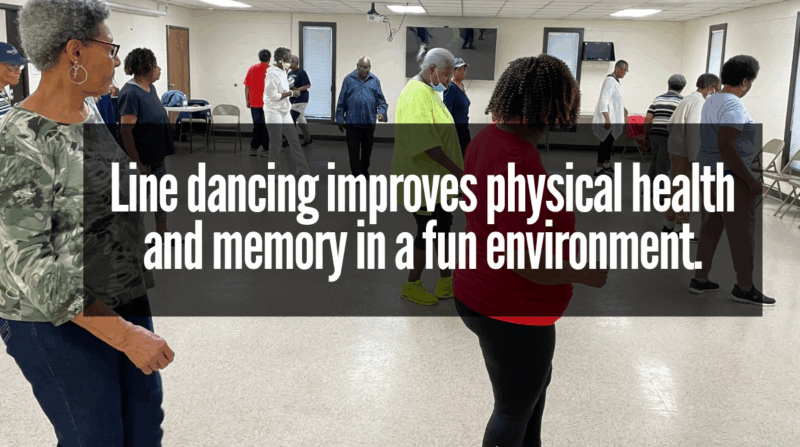
Line dancing is one of their most popular classes at Brown & Douglas. According to an internet article, line dancing provides a positive impact on brain health by “improving memory, cognitive function, and reducing stress, anxiety, and depression, all while promoting social interaction and a sense of community.”
In particular:
*Memory. Line dancing requires you to remember the sequence of steps to the rhythm of the music. Studies have shown that line dancing improves neurological functions.
*Balance and coordination. Moving your feet quickly to the steps requires you to maintain your balance and coordination, helping to build confidence in your ability to walk safely, which can improve risks of falls.
*Improves heart health. By moving quickly to different speeds of the line dance, you’re getting an aerobic workout that improves heart function, reduces high blood pressure, stress and high cholesterol levels.
*Socialization. Line dancing is a group activity and a great way to meet new friends and enjoy a shared activity. Spending time with friends in an enjoyable activity elevates your mood and increases those important endorphins that can even decrease pain and depression.
Pam Benton teaches a line dancing class on Thursdays at 3 p.m. at Brown & Douglas. Over two dozen ladies, (and a few men on occasion) come regularly to her line dancing class. Benton has been line dancing for over ten years and teaching for over five years, both at Brown & Douglas and other locations. “Line dancing is good exercise, good for memory,“ she said, “remembering the dance step sequence, and which wall to face when you turn.”
Benton says line dancing is also good for mental health. “When I come in this door, my heart is free and I’m in my zone, my safety zone. I’ll deal with the world when I go back out that door.”
Line dancing can be done at any age. Shirley Williams, age 89, comes to Benton’s classes. She said, “I need to get out of the house and do something.” Williams said she has arthritis, and she didn’t want to take more pills, “so I come here to keep moving.”
Movement & Memory Go Hand in Hand
Deborah Miller has been teaching the Movement & Memory class at Brown and Douglas for nearly three years. She includes stretching and movement exercises along with activities that focus on memory, following direction, dexterity, and socialization. Miller said she researches some activities online and sometimes she adapts games or makes them up to keep the class interesting and fun.
During a recent class she first had everyone go around the room and introduce themselves, then she called on different participants to see how many people they could correctly name. That started everyone laughing. Then she divided the room into two lines for a rousing game of “Noodle Hockey.” One side had an orange noodle and the other had a green noodle. The goal was to stay seated in your chair as you used the noodle to swing at a small ball (the “puck”) and try to knock it into the basket at either end of the line. The competition was fierce! The game not only was great exercise for the body but also for the brain as teams tried to anticipate where the ball was going and to shout out directions to their teammates.
There was also a version of “Simon Says” in which participants in a line had to quickly determine what direction to step based on the color Deborah shouted out. Green left, red right, blue center – it seemed simple at first, but became harder to keep your brain and your feet moving in the right direction when the colors are shouted out faster and faster.
Claudia Turner, who has been going to Movement & Memory since it started, said “It’s exciting because it’s never the same. We never know what to expect.” She likes how Miller changes the class up all the time. She especially likes the oldies music Miller plays. “We have had exercises to music from the ‘60s, which we all know.” She added, “Competitiveness allows us to think differently from what we do day to day. We have become friends – and it’s fun!”
Brain Health: Alzheimer’s a Top Concern for Older Adults
Brown & Douglas held a series of classes on Brain Health. Alzheimer’s appeared in the top five of several studies on what seniors fear most as they age. Felecia Bennett-Giles, who is with the Alzheimer’s Research Center at Atrium Wake Forest Health, and intern, Niyanna Fields, who is in Winston-Salem State University’s health management program, presented an informative talk on Alzheimer’s.
Some of the facts Niyanna presented were that African Americans with Alzheimer’s disease account for 21.3% of cases and the majority are people aged 65 and older. Two-thirds of those with Alzheimer’s are women.
Interestingly, only 8% of African Americans are involved in clinical trials of medications for Alzheimer’s. Because the percentage is so low, there is no way to know exactly how the medication will affect them. There is a great need for more Black people to join in research studies. Some studies are testing physical and memory changes as we age, and others are testing new medications that may slow the progress of Alzheimer’s. Studies are free to join and offer a stipend for participation.
Fields noted that there are three stages in Alzheimer’s: the early stage with mild symptoms that could begin years before it is diagnosed; the middle stage where the symptoms are more moderate and is the longest of the stages; and the late stage that is the most severe and where patients often exhibit an inability to react to their surroundings, have communication difficulties, and have a need for extensive care.
There are also ways to reduce your risk of developing Alzheimer’s, including: don’t smoke; drink less alcohol; protect your head by avoiding falls; manage blood pressure; eat a healthy diet; and do brain exercises, such as puzzles, reading, and memory games.
Bennett-Giles noted, “Alzheimer’s just doesn’t affect a person; it affects a family.”
The Alzheimer’s Center is conducting clinical trials with a goal to boost diversity across demographics. The trials offer hope to affected individuals, as well as future generations.
Bennett-Giles summed up participating in a clinical study this way: “It’s like planting a tree that you won’t be able to enjoy its shade.”
Aging Well Informs, Educates and Entertains
Deb Burcombe moved to Winston-Salem when her husband accepted a position at (then) Wake Forest Baptist (now Atrium Health Wake Forest Baptist). Deb was offered a position at the J. Paul Sticht Center for Healthy Aging and Alzheimer’s Prevention. As she got to know the researchers and the research they were doing on aging and Alzheimer’s, she wondered “how can we create a method of sharing these amazing discoveries with older adults?” She approached her supervisors about an idea she had to host a seminar, but they didn’t think the general public would be interested enough to attend.
Deb felt differently, so she convinced a doctor to join her in launching a new initiative, “Aging Well.” She chose the location of the Central Public Library because it was free, it was downtown and on a bus route, and the time of 5:30-6:30 p.m. so people just getting off work could attend and still get home in time for dinner. To their surprise, the first Aging Well seminar attracted over 150 people!
Since the debut of Aging Well on April 10, 2018, the monthly sessions continued to draw consistently large audiences who came to hear experts talk on topics such as: Aging & Memory: What’s Normal and What’s Not? Understanding Dementia: Strategies for Common Challenges. Legal Tools to Combat Exploitation and Abuse of Older People. What To Do When the Holidays Aren’t so Jolly. Not only did the audiences love it, but the presenters did also,. The medical professionals may have been hesitant before they spoke, but afterward they couldn’t wait to do it again. Aging Well was a huge success!
And then the pandemic hit.
Like many of us, in the beginning we thought it would only be around for a couple months, so Aging Well in person was paused, but not ended. Deb knew that it was needed now more than ever. “We never considered not continuing because it was too important.” Deb and her team, which now included Courtney Hayes, who was with the Best Health Center formerly located in Hanes Mall, Audrey Bell-Farrow, and Tom Roth, looked at a few platforms and Deb contacted professionals at Zoom, which was just beginning to become an accepted form of connecting people. She didn’t want a Zoom full of talking heads for an hour because she thought it would quickly become boring.
“Aging Well had a history of being fun and informative and I wanted to keep the fun part,” Deb said. She thought, what is important to people aging well? Eating well, definitely. Everyone was in lockdown, but what would they like to go on a weekend if they could? Explore, visit new places, have adventures. And of course, learn more about staying healthy even if you’re stuck inside.
The first part – eating well – became a cooking lesson with a local chef. Aging Well teamed up with restaurants that were open and doing take-out meals to give a demonstration of how to create one of their signature dishes, and at the same time promote the restaurant’s take-out service. It was a win-win for both, and the restaurants were grateful for the chance to promote their business.
The explore segment became tours of local places that were safe to visit, such as parks and gardens. They filmed tours of Reynolda House, Korner’s Folly, and Seagrove potters, among many others.
The health portion includes exercises you could do at home, such as chair yoga and using items such as bags of flour or soup cans as weights. And the medical professionals were still eager to present on topics such as mental health, heart health, diabetes, and how to talk to your doctor. There was even a session on how to protect yourself from scams.
Not only did the regulars continue to tune in to Aging Well the second Tuesday of every month at 5:30 p.m., but the audience also grew – from the Triad, to across North Carolina, the United States, to England, Ireland, Belgium, Germany, Canada, Costa Rica and other places. Learning how to “age well” was a topic of interest to people from literally around the world.
The accomplishments of Aging Well in educating older adults (and younger adults, as well) and providing an invaluable social connection for the past seven years have not gone unrecognized. Aging Well received The Chronicle’s For Seniors Only Community Service Award in 2021-22. The Central Library received an award for its partnership with Aging Well. In addition, Aging Well received the Clinical Research Award from the WFU School of Medicine in 2024.
Looking back at all the Aging Well team has accomplished, taking a “what-if” idea and molding it into a successful community service, creatively pivoting and forging through the unknowns of the pandemic, and creating a much -anticipated valuable monthly webinar, Deb summed it all up quite succinctly.
“We’re giving people the tools to empower them to live their best life.”
Resources:
*Brown & Douglas Active Adult Center, 4725 Indiana Ave., 336-737-8000, www.WePlay.ws and click on Facilities, Recreation Centers.
*J. Paul Sticht Center for Healthy Aging and Alzheimer’s Prevention research studies, 1 Medical Park Blvd., Winston-Salem. 336-713-8575. https://school.wakehealth.edu/research/institutes-and-centers/sticht-center.
*Aging Well webinar, second Tuesday of each month, 5:30-6:30 p.m., virtually. To get the link to the webinar, call 336-713-2378.