
Staff Report
Winston-Salem Chronicle
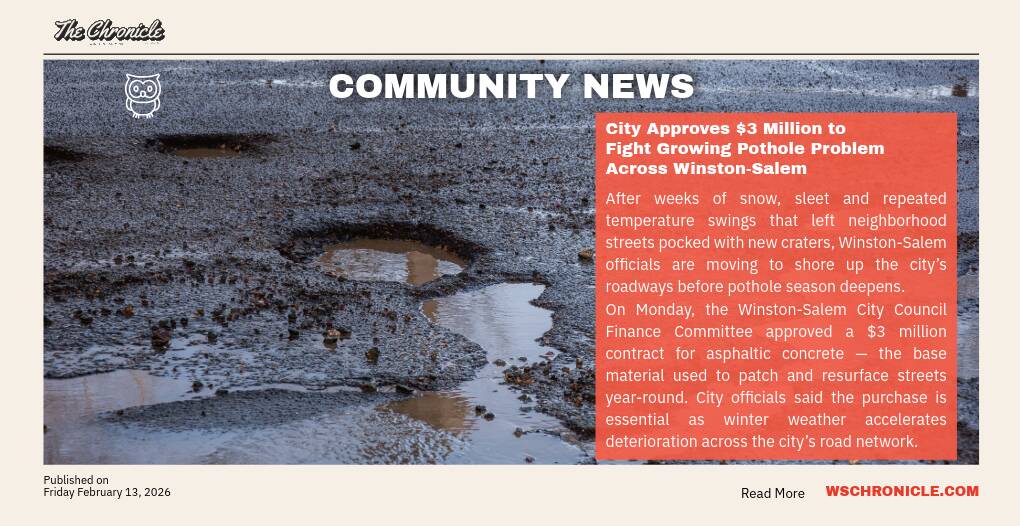
After weeks of snow, sleet and repeated temperature swings that left neighborhood streets pocked with new craters, Winston-Salem officials are moving to shore up the city’s roadways before pothole season deepens.
On Monday, the Winston-Salem City Council Finance Committee approved a $3 million contract for asphaltic concrete — the base material used to patch and resurface streets year-round. City officials said the purchase is essential as winter weather accelerates deterioration across the city’s road network.
The decision comes as infrastructure quality faces renewed scrutiny statewide. The American Society of Civil Engineers recently released its 2026 Infrastructure Report Card for North Carolina, assigning the state’s roads a “C-” grade. While Winston-Salem’s streets perform better than some national averages, engineers continue to warn that aging pavement and increasingly volatile weather patterns are placing added stress on local infrastructure.
Why Potholes Multiply After Winter Storms
For many residents, the damage appears almost overnight.
Civil engineering experts attribute the sudden eruptions to a freeze-thaw cycle. Water from snow and sleet seeps into small cracks in asphalt. When temperatures fall below freezing — as they did repeatedly over the last two months — that water expands as it turns to ice, widening the cracks. When temperatures rise and the ice melts, gaps remain beneath the pavement surface. Under the weight of daily traffic, weakened sections collapse, forming potholes.
City crews have already used more than 1,000 tons of salt this season to keep primary routes passable. While necessary for safety, salt can intensify the freeze-thaw cycle by lowering the freezing point of water, contributing to faster pavement breakdown.
A Year-Round Material
Purchasing Director Darren Redfield told committee members the $3 million allocation covers asphaltic concrete the city uses throughout the year.
“In the winter, we do the pothole patching, and then in the warm months, we do the resurfacing and paving repairs,” Redfield explained during the Feb. 10 meeting.
The contract is structured as “as-needed,” allowing the city to draw material when damage occurs instead of waiting for a scheduled paving cycle — an approach officials say provides flexibility during unpredictable weather.
Budget Pressures, Public Safety
The approval comes during a tight budget season. More than 70 community agencies are competing for a combined $1.5 million in city funding, placing added pressure on elected officials as they weigh priorities ahead of the full budget adoption in June.
Still, council members signaled that road repair remains central to public safety and daily quality of life. Damaged streets can lead to vehicle repairs, traffic hazards and slower emergency response times — burdens that often fall hardest on residents in neighborhoods with older infrastructure.
As the meeting concluded, Council Member Robert Clark emphasized the scale of the challenge ahead.
“You’re going to need a lot,” Clark said, referring to asphalt supplies. “Because freezing creates potholes.”
With additional temperature swings possible before spring stabilizes, city field operations crews are preparing for an active repair season. For residents navigating cracked pavement and uneven lanes, the $3 million investment represents both an immediate response to winter’s toll and a reminder of the ongoing work required to maintain the city’s foundation.