
By Derwin L. Montgomery
The Winston-Salem Chronicle
WINSTON-SALEM — What began as a routine $10 subscription payment has become a cautionary tale for the entire community.
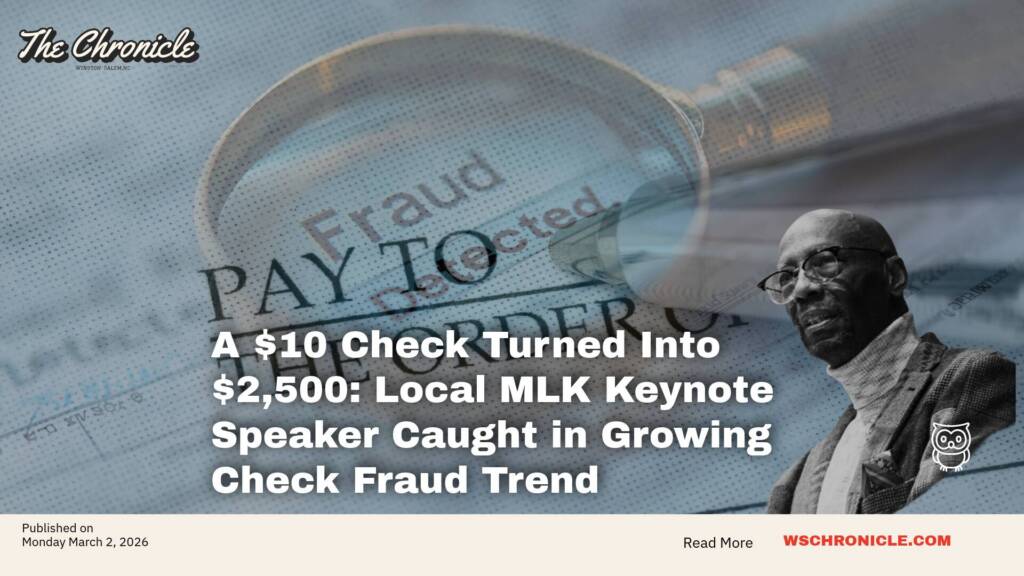
Dr. Larry D. Little, who recently delivered the keynote address at Winston-Salem’s annual Martin Luther King Jr. Prayer Breakfast, said he was stunned to learn that a check he placed in a U.S. Postal Service collection box had been altered and cashed for $2,500.
The check, originally written for $10, was “washed” — chemically altered to remove the original amount and rewritten for a far larger sum. The incident required Dr. Little to file a police report and work directly with his bank in an effort to recover the stolen funds.
“It was shocking,” Dr. Little told the Chronicle. “You never think something like that will happen from something so simple.”
His experience reflects a rapidly growing form of financial crime that federal investigators say has surged nationwide — and increasingly in North Carolina.
What Happened
According to Dr. Little, he wrote a check for a subscription payment and deposited it in a postal drop box. At some point before reaching its intended destination, the check was intercepted.
The amount was altered from $10 to $2,500 — a tactic commonly known as check washing. In many cases, thieves use chemicals to remove ink, then rewrite the payee name and dollar amount. Sometimes the stolen check is also used to create counterfeit checks bearing the victim’s account information.
Dr. Little discovered the fraud after reviewing his bank account activity. He then:
- Filed a police report
- Contacted his financial institution
- Began the dispute process to attempt reimbursement
Banks typically require a formal fraud affidavit and supporting documentation before investigating and crediting funds, a process that can take weeks.
A Broader Pattern
Federal authorities have warned that check fraud — particularly mail-theft-related check washing — has nearly doubled in recent years.
The U.S. Treasury Department’s Financial Crimes Enforcement Network has documented hundreds of thousands of suspicious activity reports tied to check fraud annually. Law enforcement agencies across North Carolina have also issued public warnings about rising mail theft and altered checks, especially during tax season.
The method is straightforward:
- Thieves target outgoing mail — often from residential mailboxes or blue collection boxes.
- Checks are chemically altered or used to create counterfeits.
- Funds are withdrawn quickly before victims detect the fraud.
Investigators say criminals move fast because banks are required to make certain funds available within specific timeframes. That means money can be withdrawn before fraud is discovered.
Why This Matters for Winston-Salem
Checks remain common in Winston-Salem — particularly among:
- Seniors
- Small business owners
- Churches and nonprofits
- Residents who prefer traditional payment methods
For many Winston-Salem households and legacy institutions, checks are still a trusted and familiar tool. But that reliance may now carry increased risk.
Dr. Little’s case underscores a sobering reality: even community leaders and financially savvy residents are vulnerable.
And the financial harm can be significant. A $2,500 loss can disrupt rent payments, utility bills, payroll, or household budgets.
What Residents Can Do
Law enforcement and consumer protection officials recommend:
- Avoid leaving outgoing checks in home mailboxes with the flag raised.
- Drop mail inside the post office or hand directly to a clerk.
- Use gel pens (which are harder to chemically wash).
- Monitor bank accounts frequently — weekly at minimum.
- Set up text or email transaction alerts.
- Consider electronic payment options when secure and available.
If fraud is suspected:
- Contact your bank immediately.
- File a police report.
- Report mail theft to the U.S. Postal Inspection Service.
- Keep copies of all documentation.
The Road Ahead
Dr. Little is now working through the formal banking process to have the funds replenished. Financial institutions typically conduct investigations before issuing permanent credits.
Meanwhile, law enforcement officials continue urging residents to treat outgoing mail — especially checks — as sensitive financial documents.
For the local community, the lesson is clear: something as ordinary as a $10 check can become a costly ordeal.
Residents who have experienced similar incidents can contact the Winston-Salem Police Department non-emergency line and report mail-related theft to the U.S. Postal Inspection Service at uspis.gov.