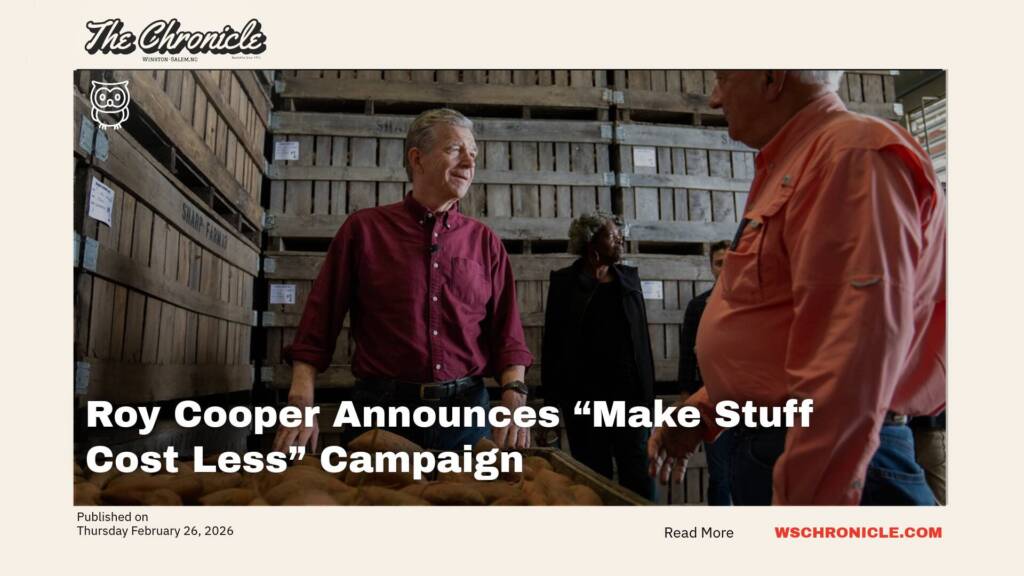








Cooper Highlights Health Care Affordability Plan During Greensboro Stop of “Make Stuff Cost Less” Tour

Staff Report
The Winston-Salem Chronicle
Former North Carolina Gov. Roy Cooper brought his statewide “Make Stuff Cost Less” tour to the Triad this week, outlining a new plan aimed at lowering health care costs for families and challenging federal policies he says are driving expenses higher.
Speaking to supporters and health care advocates during a stop in Greensboro this week, Cooper said rising medical bills and insurance barriers are placing increasing strain on working families across North Carolina.
“North Carolinians are struggling with skyrocketing health care costs and insurance companies that are ripping them off,” Cooper said during the event. “Washington, D.C.’s attacks on health care are driving up costs and making it harder to get care. In North Carolina we brought Democrats and Republicans together to make health care more affordable and accessible, and I’ll bring that same common sense to the U.S. Senate.”
The event marked the second major policy rollout of Cooper’s affordability-focused campaign tour. Earlier this month, he released a proposal targeting grocery prices. The new announcement focuses specifically on health care costs — an issue that has become a central concern for families across the state as insurance premiums, prescription prices and medical debt continue to rise.
A personal story from Winston-Salem
Among those joining Cooper at the event was Winston-Salem resident Meredith Vaughn, a health care professional and mother whose 12-year-old daughter lives with cerebral palsy and relies on Medicaid for treatment and support services.
Vaughn said the coverage has been essential for her family.
“I’m a health care professional and a mom to my amazing 12-year-old daughter who has cerebral palsy and relies on Medicaid to get the care she needs to lead a full life,” Vaughn said. “Without this help, we simply can’t afford to provide what our daughter needs. No parent should have to choose between groceries and the health care their child needs.”
Her story underscored the broader stakes of the policy discussion for families across North Carolina, where many households face difficult choices between basic expenses and medical care.
Key elements of Cooper’s health care plan
Cooper’s proposal outlines several steps he says would reduce health care costs and strengthen consumer protections if enacted at the federal level.
Among the priorities:
- Allow doctors — not insurance companies — to determine appropriate treatments and reduce insurance denials of coverage.
- Restore Affordable Care Act tax credits and reverse proposed cuts to Medicaid coverage that could leave people uninsured.
- Expand Medicare’s authority to negotiate prescription drug prices with pharmaceutical companies.
- Increase federal oversight of hospital mergers and acquisitions to prevent consolidation that can drive up prices.
- Regulate pharmacy benefit managers, the middlemen who negotiate drug prices but are often criticized for raising costs and squeezing independent pharmacies.
- Limit “surprise billing” by capping out-of-network charges for non-emergency care and expanding protections for ambulance services.
- Cap annual out-of-pocket prescription drug costs for consumers.
- Require hospitals to automatically enroll eligible patients in charity care programs to reduce medical debt.
- Strengthen price transparency so patients can compare costs for common procedures and tests.
Health policy experts have increasingly raised concerns about consolidation within the health care industry and opaque pricing systems that leave patients unaware of costs until after receiving care.
Building on North Carolina policy efforts
Cooper pointed to recent policy changes in North Carolina as examples of bipartisan solutions that could be expanded nationally.
In 2023, state leaders approved Medicaid expansion through the Affordable Care Act framework after years of debate. The policy extended coverage to hundreds of thousands of low-income working adults.
State officials say nearly 715,000 North Carolinians have gained coverage through the expansion.
Supporters argue the move not only improved access to care but also stabilized struggling rural hospitals by bringing additional federal health funding into the state.
Cooper also highlighted a statewide initiative designed to address medical debt. The program aims to relieve more than $6.5 billion in outstanding medical debt for roughly 2.5 million North Carolinians and prevent future debt accumulation through hospital policy changes and financial assistance programs.
Medical debt remains one of the most common forms of consumer debt in the United States, often affecting families who believed their insurance would cover necessary treatment.
Why it matters for Triad residents
Health care affordability continues to rank among the most pressing concerns for residents across the Piedmont Triad, particularly as hospitals, insurers and pharmaceutical companies face increasing scrutiny over pricing.
In communities like Winston-Salem and across Forsyth County, local leaders and health providers have warned that rising costs can discourage preventive care, worsen chronic illness outcomes and deepen economic disparities.
Families with children who require specialized medical care or long-term treatment are often among those most affected.
What comes next
Cooper said the Greensboro event is one of several stops planned across North Carolina as he continues the “Make Stuff Cost Less” tour in the coming weeks.
Future stops will focus on additional cost-of-living issues, including housing affordability, utility costs and child care — all areas that have become growing financial pressures for working families.
The tour is expected to include meetings with residents, health professionals and community leaders across the state as Cooper outlines his broader economic agenda.
For many North Carolinians, the debate over health care affordability will remain closely tied to broader questions about access, equity and the role government should play in controlling costs.