







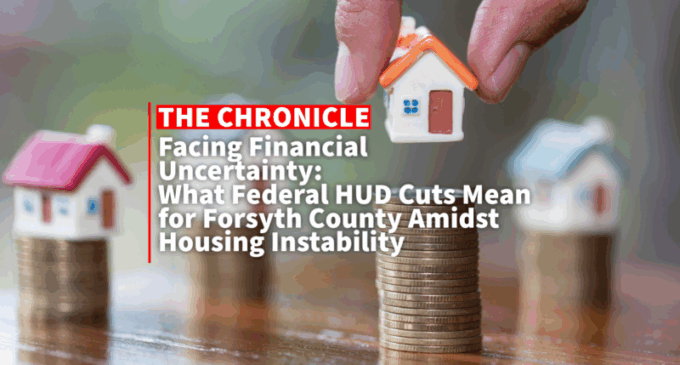
Facing financial uncertainty: FY2026 budget proposal puts local housing and homeless programs in jeopardy
Part 2
JESS SCHNUR
THE CHRONICLE
The Bigger Picture
With the uncertainty surrounding President Trump’s FY2026 budget proposal continues to circulate across the country, several federal departments have found their funding threatened for the upcoming fiscal year. As Congress prepares to deliberate and decide on the final budget, many programs – such as the Federal Emergency Management Agency (FEMA), the U.S. Department of Agriculture (USDA), and the Low-Income Home Energy Assistance Program (LIHEAP) – find themselves vulnerable to cuts in the Trump administration’s proposal.
Among the government institutions set for the chopping block, the Department of Housing and Urban Development (HUD) is currently facing a potential 44% overall reduction in funding, according to the Oval Office’s budget layout. The proposal aims to shift the financial responsibility of housing assistance solely to state governments.
Through the Local Lens
Last week, The Chronicle spoke with Ted Ortiviz, executive vice president of operations for the Housing Authority of Winston-Salem (HAWS), to gain insight into what these cuts could mean for HUD-funded programs that many in the community rely on.
This week, The Chronicle spoke with Shereka Floyd, the City of Winston-Salem’s housing programs manager, to discuss what the federal proposal could mean during an already heightened period of housing instability and homelessness within the community.
As housing programs manager, Floyd serves as a liaison between agencies and local governments. She oversees and facilitates local homeless programs, such as those funded by Continuum of Care (CoC) initiatives. CoC is made up of local service providers, advocates and local governments working together to support those experiencing homelessness, as well as assisting households in need of long-term help, such as those with disabilities. The Winston-Salem CoC currently coordinates a Rapid Rehousing program that provides short-term assistance with security deposits, rent and utility costs for up to six months.
Floyd also administers community housing programs associated with Housing Opportunities for Persons With AIDS (HOPWA), Emergency Solutions Grants (ESG), HOME Investment Partnerships funds, and Community Development Block Grants (CDBG) – all HUD-funded initiatives.
“These programs have continued to grow to meet the needs of the increasing population of those experiencing homelessness,” Floyd said in an interview with The Chronicle. “Case managers within these programs continue to expand the availability of community resources to help clients become sustainable after the move into housing. These programs continue to work to house individuals who are experiencing homelessness without creating barriers to services.”
According to Floyd, HUD funding is vital to the core of these programs. Much of the assistance from the department supplements qualifying tenants’ rent, provides maintenance support for property owners and landlords, and covers utility bills and trash fees that property owners may incur.
The Growing Struggle of Homelessness in Forsyth County
According to the 2024 CoC Point-in-Time Count (PIT) – an annual HUD-mandated effort to assess homelessness nationwide – there were 485 homeless households in Forsyth County, including those sheltered in emergency or transitional housing and those unsheltered. Of these, 226 were unsheltered. This marks a stark increase from the 2023 count, which reported 330 homeless households, 85 of which were unsheltered.
In total, the 2024 PIT identified 627 homeless individuals across the county, with 234 unsheltered. In comparison, the 2023 count found 396 homeless persons, 87 of whom were unsheltered.
Each year, data from the PIT count and the work of its volunteers help the CoC evaluate the effectiveness of its efforts in supporting unhoused individuals. It informs strategy by identifying service gaps and tracking the scale of homelessness within the community.
“Overall, this data helps us understand the scope of homelessness in our community, track progress in addressing it, and develop targeted strategies,” Floyd said.
What Federal Cuts Could Mean for the County
Should the president’s proposal come to fruition, many of the city’s housing programs would see service reductions, including cuts to rental assistance, Housing Choice Vouchers (HCV), and case management jobs, Floyd explained.
Much like the “ripple effect” highlighted by Vice President Ortiviz in last week’s discussion, Floyd concurs these impacts will extend far beyond those directly facing housing insecurity.
“The funds being cut not only support those who are experiencing homelessness,” Floyd said. “These HUD funds support other programs, such as our small business loan program renovation. Since 2015, this program has provided $1.05 million in gap financing for start-up or expanding businesses, creating or retaining over 160 jobs – growth that would not be possible without this direct financial assistance for low- to moderate-income entrepreneurs. It also affects programs such as our First-Time Home Buyers’ programs, the construction of affordable housing, and even the replacement of streets and sidewalks, and the demolition of dilapidated buildings. All community members are affected.”
Additionally, property management companies and landlords who partner with these housing programs – and are therefore paid through program funding – will also face reductions in rental assistance and income.
Despite the uncertainty facing many local HUD-funded programs, the Continuum of Care and the City of Winston-Salem remain committed to serving the community. Both institutions are currently working in collaboration, meeting weekly with local organizations and foundations to pool resources in anticipation of potential federal cuts. Floyd urges residents to contribute by donating to local organizations and contacting their representatives to voice their concerns.
“The possible funding cuts within HUD will critically affect the programs that we currently administer,” Floyd said. “This will cause many households to lose access to their housing and the ability to afford rent, causing an increase in homelessness.”