
By A. J. Daniel | The Winston-Salem Chronicle
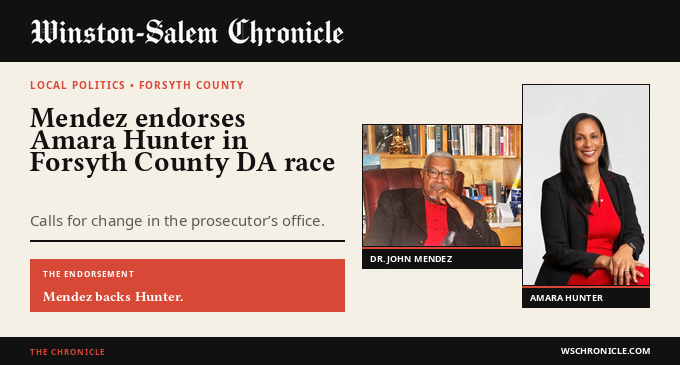
The 2026 race for Forsyth County district attorney is beginning to sharpen into a debate over experience, accountability and the exercise of prosecutorial power after longtime Winston-Salem pastor and community activist Rev. Dr. John Mendez endorsed Democratic challenger Amara M. Hunter over incumbent Republican District Attorney Jim O’Neill.
In an endorsement letter dated Aug. 10, Mendez urged faith leaders, civic leaders and residents across Forsyth County to support Hunter, describing the election as an opportunity to change the direction of an office O’Neill has led for more than 16 years.
“Our community deserves leadership that is honest, accountable, and committed to serving every family,” Mendez wrote.
The endorsement is notable not simply because Mendez is backing Hunter. His letter levels pointed criticism at the current district attorney’s office and raises allegations about racial disparities and prosecutorial practices that Mendez says Hunter witnessed while working there.
The Chronicle has reached out to O’Neill for comment regarding the endorsement and the allegations contained in the letter. He has not responded as of publication.
Hunter and O’Neill are the only two candidates currently listed for District Attorney District 31, which encompasses Forsyth County. Hunter filed as a Democrat and O’Neill as a Republican, setting up a November general election contest between a challenger who has worked on multiple sides of the criminal justice system and one of the county’s longest-serving elected law enforcement officials.
O’Neill has served as Forsyth County district attorney since 2009. Before becoming district attorney, he worked as an assistant district attorney in the office beginning in 1997.
Hunter is currently an assistant public defender in Forsyth County. State and local professional records list her as licensed in North Carolina and Michigan, with a law degree from the University of Detroit. Her campaign describes her as a former police officer and assistant district attorney.
Mendez’s letter offers a more extensive account of Hunter’s career, stating that she has more than 30 years of public service and has worked as a police officer, assistant prosecutor, assistant district attorney and public defender.
But the center of Mendez’s endorsement is not Hunter’s résumé.
It is what he says she saw.
According to Mendez, Hunter worked under O’Neill in the Forsyth County District Attorney’s Office from 2016 until her resignation in May 2019. Mendez alleges that during that period Hunter witnessed racial disparities in the treatment of defendants and was present during meetings in which prosecutors were directed to pursue Black and Brown defendants more aggressively.
Those are serious allegations.
The Chronicle has not independently verified those claims and is not presenting them as established fact. The endorsement letter does not, by itself, provide documentation establishing that such directives occurred.
But the allegations place a significant question before the campaign: What happened inside the Forsyth County District Attorney’s Office during Hunter’s tenure there, and what evidence exists to support or refute the account presented by Mendez?
That question takes on greater significance because the person Hunter is challenging is no political newcomer.
O’Neill has occupied the district attorney’s office since 2009 and has also sought statewide office. He was the Republican nominee for North Carolina attorney general in 2020 and later ran for lieutenant governor in 2024, advancing to the Republican runoff before losing to Hal Weatherman.
At home, O’Neill’s most recent race for district attorney demonstrated that the office is not politically untouchable.
In 2022, Democrat Denise Hartsfield, a former district court judge, came within a few percentage points of defeating him. O’Neill won 51.3% of the vote to Hartsfield’s 48.7%, a margin of just over 3,000 votes.
That history gives the Hunter-O’Neill race a context beyond a single endorsement.
Forsyth County voters are being presented with two very different relationships to the prosecutor’s office: an incumbent who has led it for more than a decade and a challenger who once worked inside it and now works on the opposite side of the courtroom representing people who cannot afford private attorneys.
Mendez is clearly asking voters to see that contrast as consequential.
His endorsement also invokes one of the deepest wounds in Winston-Salem’s criminal justice history: the wrongful conviction of Darryl Hunt.
Hunt, a Black Winston-Salem man, spent nearly two decades imprisoned for a murder he did not commit before being exonerated. His case has remained part of the city’s civic memory and its continuing reckoning with race, policing, prosecution and wrongful conviction.
Mendez uses that history as part of a broader argument about why prosecutorial accountability matters.
The Chronicle is not attributing responsibility for the Hunt prosecution to current candidates based on Mendez’s letter. Any specific connection between individuals, prosecutorial decisions and the Hunt case requires separate documentation.
But Mendez’s invocation of Hunt points toward the larger argument running through his endorsement: decisions made inside a prosecutor’s office can follow families and communities for generations.
That is not an abstract question in Winston-Salem.
Neither is the power of the office the two candidates are seeking.
The district attorney represents the state in criminal prosecutions in Forsyth County. The office determines how cases are prosecuted and plays a central role in the criminal court system, making its policies and internal decision-making matters of public consequence.
Mendez also raises concerns about pretrial incarceration and the length of time some defendants spend in jail awaiting resolution of their cases.
Those claims require current jail and court data before The Chronicle can independently report the scale of the problem described in his letter.
The distinction between allegation and evidence matters, particularly in an election.
An endorsement letter is advocacy. It tells voters what its author believes and why the author believes they should support a particular candidate.
Journalism has a different obligation.
Mendez’s allegations cannot become fact merely because they appear in a letter from a respected community figure. At the same time, allegations involving racial treatment and the use of prosecutorial authority should not be ignored simply because they emerge during a political campaign.
They require answers.
Hunter should be asked to describe, on the record and in detail, what she personally witnessed while working in the district attorney’s office, what actions she took at the time and what evidence or witnesses can corroborate her account.
O’Neill should have the opportunity to respond fully — an opportunity The Chronicle has already extended.
And voters should be able to examine the records, policies and outcomes of the office itself.
The 2026 district attorney’s race is therefore shaping up to be about more than whether Forsyth County prefers a Democrat or a Republican.
It is becoming a referendum on an institution.
After more than 16 years under the same district attorney, voters will have an opportunity to decide whether O’Neill’s record warrants another term or whether Hunter’s argument for a different approach — now amplified by Mendez’s endorsement — offers the direction they want the county’s prosecutor’s office to take.
Black media has historically understood the importance of watching the courthouse as closely as City Hall.
There is a reason.
Few institutions possess greater authority over an individual’s immediate freedom than the criminal justice system, and few elected officials possess more discretion within that system than a prosecutor.
Mendez has made his choice.
Now the allegations behind that choice deserve examination, the incumbent deserves the opportunity to answer them, and Forsyth County voters deserve enough verified information to make their own.