






Local editor collaborates with death row inmate on book of writing prompts
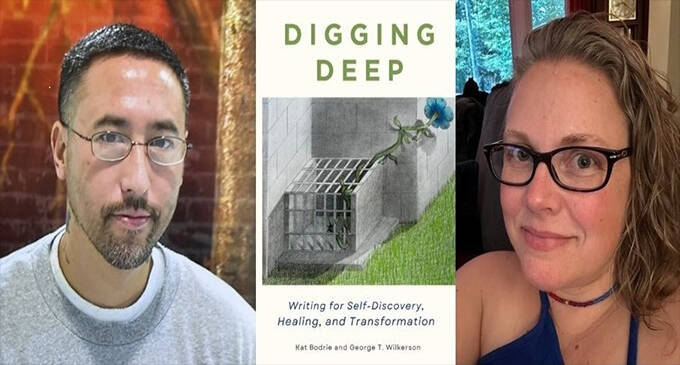
George Wilkerson and Kat Bodrie have written a new book, “Digging Deep: Writing for Self-Discovery, Healing & Transformation, due out in August.
JUDIE HOLCOMB-PACK
THE CHRONICLE
George Wilkerson and Kat Bodrie share a unique relationship. Wilkinson is an inmate on North Carolina’s death row. Bodrie is a local writer and editor. They connect over a common love of poetry, their personal journeys of introspection and self-discovery, and the importance of learning about yourself and being open to sharing their life’s journeys.
Their new book, “Digging Deep: Writing for Self-Discovery, Healing & Transformation,” is their first collaboration. The book, which began as a book of prompts on the benefits of writing, later became a book of prompts to allow readers to “dig deeper” into their emotions, whether through writing or conversations with others.
In April 2022, Wilkerson’s first book of poetry, “Interspace,” was published by BleakHouse Publishing, for which Bodrie is a book editor, and in June 2022, BleakHouse published Wilkerson’s book, “Bone Orchards: Reflections of Life Under a Sentence of Death,” co-authored with Robert Johnson, BleakHouse’s publisher, and Kat Bodrie. The trio recently published a second edition with more of Wilkerson’s writing, as well as Bodrie’s poems.
Bodrie was first introduced to Wilkerson in early 2021, after reading “Crimson Letters: Voices from Death Row,” that Wilkerson, along with three other men from death row, co-authored. Bodrie, who is a member of Winston-Salem Writers, purchased the book and was impressed with Wilkerson’s essays. “His essays were what I connected with the most, which is odd because we have such different life experiences,” she said. “Ever since the beginning I felt like there was some sort of spiritual connection.”
Later Bodrie volunteered with “Crimson Letters” as an editor and when she sent Wilkerson edits to one of his essays, she decided to include a letter about herself since they were both poets. They began sharing their poetry and feedback on their poems, and their relationship has continued since then.
Bodrie and Wilkerson’s first collaboration, “Digging Deep: Writing for Self-Discovery, Healing, & Transformation,” is available for free to inmates through the Human Kindness Foundation (HKF) via tablets that have the Edovo app, which inmates can use to access educational videos and reading materials.
Wilkerson, who is 44 years old and has been in prison since 2005, talked about his writing journey in a July 3 Zoom interview with The Chronicle. An award-winning writer who has had many of his essays and poetry published, he did not start writing until 2013 when writing classes were offered in prison. He said, “I had no desire to write; no one ever even encouraged me at all. … In fact, I didn’t understand the appeal for the people who did write. Being where I am, on death row, we don’t have access, generally speaking, to programs, activities.”
That all changed when he saw a flyer advertising writing classes. “One day they posted in the pod a flyer advertising death row’s first ever writing class – they called it ‘Writing from Captivity.’”
The class would study writers throughout history who had experienced some form of imprisonment or captivity. Every week they would look at a different genre of writing, such as fiction, nonfiction, or journalism. One class was on poetry and the presenter had them do a poetry exercise using words that had been cut from magazines to create a poem they would glue to poster board. That experience opened Wilkerson’s eyes to how you can express feelings through poetry.
“Just the concept to being able to communicate in a different way, not having to strictly use the rules of grammar. … when I completed my poem, it was like I had an epiphany. Regular writing, prose writing, was like linear in the way you have to present the information, but my real-life experience is multi-sensory.” He explained, “Since poetry is not bound strictly by the rules of grammar, it is able to communicate in a multi-dimensional way. … At that moment I kind of fell in love with poetry.”
Wilkerson is also an avid reader. “The first year that I was incarcerated I spent in solitary confinement, so I did a lot of reading then and I really fell in love with reading.”
Initially Bodrie and Wilkerson discussed the “Digging Deep” prompt project and how it would encourage writing. Bodrie said, “We read Bene’ Brown’s book that came out called “Atlas of the Heart,” which is about emotions. So, we’re like, hey, we can use this book for our prompt book … let it inspire the prompts that we write.”
Soon, Bodrie noted, the project started to go in a different direction than they originally thought. It moved away from the benefits of writing and more toward emotional healing, processing life’s experiences, and reframing them in different ways.
Wilkerson was handwriting most of the first prompts drafts and sending them to Bodrie because he doesn’t have access to a computer, and she was typing them up. Bodrie said, “This book literally took four years to write. … It was one of the first, if not the first project we thought of collaborating on together.”
Bodrie said for a long time they were “just doing the prompts because we believed in their benefit and how they could help other people. And eventually we said, why don’t we write our responses to our own prompts?”
As they wrote the prompts, they also engaged in them, experiencing self-discovery in real time. They asked themselves difficult questions and were authentic, honest and vulnerable in their answers. They wanted people who read the book to be able to connect with them, especially if they were in solitary confinement.
Wilkerson said as he learned more about emotional awareness, he felt he was being transformed. He said prison has a distinct, negative culture and the changes he was experiencing were setting him free from the reactive nature of the prison environment.
Wilkerson shared some of the things in the book with the men where he is and everyone has been really positive about the book. He is especially excited to see the project come to fruition. Every prompt in the book is accompanied by artwork, mostly by Wilkerson, who is also an accomplished artist. “I’m impressed, I’m proud, especially when they see all the artwork that’s involved in it, and how easy the prompts are to understand.”
One thing Wilkerson feels has been an obstacle is that, like him, some people prefer physical books. “I can read something on the tablet, but to actually try to engage with it, take notes with it, I don’t really like relying on a digital device to do that, especially when the wi-fi is glitchy. And I think some of the other guys are the same way.” He has had several men tell him that “when the book comes out, I want a copy.”
Getting the book printed so that it can be distributed to prisoners – or others who are interested – is a personal goal of Bodrie. She has recently been working with HKF to distribute the book in print. “They are also doing a lot of work with emotional awareness,” said Bodrie, “which is how our work dovetails with theirs.”
In August “Digging Deep” will be available for free to prisoners who request a printed copy from HKF and will also be available to the public on their website. HKF has agreed to print 1,000 copies, and Bodrie said she hopes to raise $3,500 to print an additional 1,000 copies and to cover the cost of shipping the books to HKF, which will then distribute them to prisoners.
Bodrie is appealing to the public to contribute to the “Digging Deep” project. To contribute, you can go to humankindness.org/donate and add a notation in the comments section that the donation is to go to the “Digging Deep” project. Any donation of $50 or more will receive a free copy of the book. Bodrie said she hopes to raise the money by the end of July so that the book can be printed in August. She has already received a few donations, about one third of the way to the goal.
Since they’ve finished the book, Wilkerson and Bodrie have started work on additional projects to follow up to “Digging Deep.”
“This book should have already existed,” said Bodrie. “George and I have just been minding these things within ourselves in order to create something that really is timeless. You can do the prompts at any time in your life, you can do them now, you can do them five years from now, ten years from now, and you’re going to get something different out of it every time.”
For more information on Kat Bodrie, George Wilkerson, and the “Digging Deep” project, go to katbodrie.com.