







Radio Trailblazer: Mütter Evans speaks about her 45 years in radio, and more
Mütter Evans
By Judie Holcomb-Pack
Mütter Evans and WAAA radio are synonymous in Winston-Salem; you can’t think about one without thinking about the other.
“My parents never limited me as to what I could do,” Evans said in an interview with The Chronicle. Growing up on a farm in Eastern North Carolina, hard work was necessary, and she worked hard.
Her work ethic was the foundation for her success as a student at Wake Forest University and beyond. Her passion had always been to be a broadcast journalist and attending Wake Forest University allowed her to prepare for a future in the media, since they had their own radio station, WFDD. When she visited as a high school senior, she learned that taking the course in broadcast management was required before working with WFDD, which would provide the foundation of the rest of her educational goals and gaining on-air experience. Her ultimate goal was to work in television.
In her freshman year in the fall of 1971, there were fewer than 100 Black students, and of that 21 were freshmen, five women and 16 men. She attempted to register for the broadcast management course during her first semester, but it was not approved. It was considered a major course, and she would have to wait until junior year. Not to be discouraged, Evans requested a meeting with the chairman of the Mass Communications Department (who happened to be Dr. Franklin Shirley and was also the mayor of Winston-Salem.) He approved her appeal for the course and that allowed her to begin learning and working part-time at WFDD during the spring semester of 1972 and throughout her entire time at Wake.
That experience gave her the background she needed when she applied and began working at WAAA in the summer of 1974 before her senior year at Wake, and she continued to work part-time until Christmas. In January of her senior year, she took a one-month winter course that allowed her to work full-time at WGHP TV in High Point and gain experience in news, which further advanced her career in media. She was offered a job for the remainder of the semester, but because of her full class load and having to commute to High Point, she turned it down.
She had also discovered that covering television news stories made her more recognized on campus and in the community, which made her uncomfortable. “I’ve always been a private person,” Evans explains. “I changed my focus to radio because people kept recognizing me and knowing more about me than I wanted them to know.”
She graduated in 1975 with a degree in Speech Communications and Theatre Arts.
Before graduation, she stopped by WAAA to see her former co-workers. Robert B. Brown, the owner, was there and after a discussion, he offered her the job as news and public affairs director beginning in June. She would later be promoted to sales, where she did everything from writing and recording commercials to selling advertising and creating promotions. Richard Miller, who also worked in radio, now with WTOB, recalled her visiting his parents’ store on Trade Street, Miller Variety Store. “She came in the store and sold them advertising,” Miller said. “She did a good job, worked her butt off to make it happen.”
Evans had learned the radio business inside out through her classes and part-time work during school and summers. She was promoted to executive vice president and things were going well until Brown announced that he was going to sell the station. Evans was surprised when he offered her the first right of refusal.
“I’m in my 20s! I’m not ready for that!” Evans recalled. Brown told her, “Life doesn’t always unfold on your timetable.”
“I’ve never been afraid of challenges,” Evans said. She discussed the opportunity with her parents. Her father had always encouraged her, and her mother was her ‘safety net’. She cautioned her, “You’ll be in debt for the rest of your life”; however, her dad told her he didn’t “know many people who had anything that they didn’t go into debt for.”
Evans seized the opportunity, beginning her remarkable career in radio.
The FCC approved her application to purchase the station in the fall of 1979. In August she held a press conference to announce that she was buying the station. WAAA originally went on air in October of 1950 with Black programming, but it had always been owned by a white male. It was the third fully Black-programmed radio station in the U.S. at that time. At 26, Evans would be the youngest Black to own a radio station and in the same week, the second Black woman to have her application of ownership approved by the Federal Communications Commission.
Evans served as owner, general manager and president of WAAA from 1979-2005.
Evans said, “The early years were full of challenges, but I had core people who worked with me.” Evans built on the reputation WAAA had for its Black programming and although there were challenges, she overcame them. She related one of the challenges the station faced: “There was a song that everybody else was playing but the message didn’t fit our station,” she explained. She discussed the situation with her program and music director but made the decision not to play the song due to the nature of it, standing strong on her conviction that WAAA had a responsibility to reflect positive messages to the community. It was hard to go against the trend, but she held fast to her beliefs.
Fleming El Amin recalled the days he worked at WAAA in the early ‘90s. He said, “I worked for WAAA evenings in news, but she suggested I do the Midnight Jazz session because it would fit my schedule better.” He also noted that she has always been a consistent organizer. “She was involved in the effort to organize the march to free Nelson Mandela in Washington, D.C. She also worked with Big Brothers Big Sisters to take kids to Carowinds.” El Amin noted, “Her voice and connections were always evident.”
Speaking about her years at WAAA, Evans said, “I worked hard, but also had a lot of fun.” She continued, “It was not just a job that I took seriously; it was a labor of love.”
Radio wasn’t Evans’ only passion. There had been a push to make Martin Luther King Jr.’s birthday a national holiday since his assassination in 1968, and WAAA had encouraged its listeners to write letters of support to Congressman Steve Neal and started petitions. Evans looked around expecting someone to start a celebration for his birthday and discovered no one was doing it. “You can’t wait for someone else to do something,” she commented. “Sometimes you have to be part of the solution.”
On Jan. 15, 1981, Evans and WAAA hosted the first Martin Luther King Jr. birthday celebration on the plaza of NCNB (now Liberty Plaza) in downtown Winston-Salem. Nationally, there was a 15-year campaign to get federal recognition before President Ronald Reagan signed it into law on Nov. 2, 1983, to go into effect the third Monday in January in 1986. It took until the year 2000 before all 50 states recognized it as a state holiday.
Evans’ MLK celebration, begun in 1981, has continued ever since. It is now the MLK Noon Hour Commemoration and although it moved around to a few different outside locations in the beginning, it is now held at Union Baptist Church. The 45th annual event was held on Jan. 20 this year. Evans, who doesn’t like being in the limelight and is usually the emcee, was the keynote speaker for the first time. Five “Dare to Make a Difference” awards were presented to community leaders.
In the early 2000s radio stations began to move toward more FM programming. As the song goes, ‘Times, they are a-changing.’ Evans said, “Things changed a lot in the industry. AM stations were losing to FM stations.” The competition was tough in the local market and Evans decided the time to retire was right and in 2005 she sold WAAA.
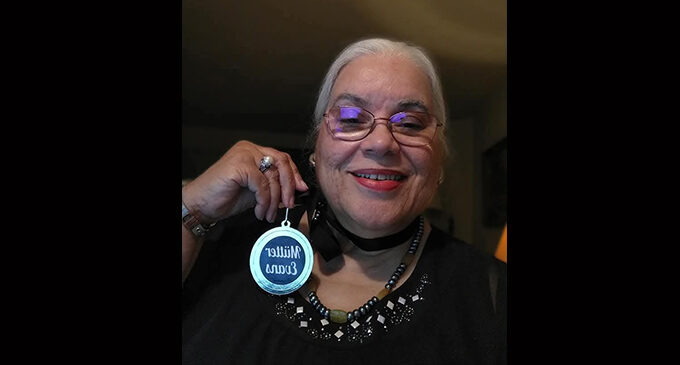
In 2022 Evans was inducted into the National Black Radio Hall of Fame. That was during COVID, so the ceremony was held virtually, but she received her award and medal, for which she is very proud. Richard Miller said the honor was well deserved. “She always had a positive outlook, was never overtly political. … She had a clear sense about what she had and what she wanted to do, and it worked for her. She liked radio and she was good for radio.”
El Amin said, “She is the icon for communication for the city of Winston-Salem.”
Throughout her life, Evans has notched several firsts on her belt: first Black woman to own a radio station; first of two women and the first Black woman to serve on the board of Winston-Salem Chamber of Commerce; and served on the founding committee for Leadership Winston-Salem.
Retirement for Evans doesn’t mean stepping back from community service. She will continue with the annual MLK Noon Hour Commemoration, participating in local community events, and she plans to start writing her memoir. Considering the celebrities she’s met over the years, both in radio and at the National Black Theatre Festival, she should have enough stories to fill a book – or maybe even two. And she’ll always be looking for something new to explore.
“As long as you live, you can learn,” Evans said.