








Research studies for new treatments offer hope for glaucoma patients
By Judie Holcomb-Pack
The Chronicle
Glaucoma has been called “the sneak thief of vision,” because in the early stages there are no symptoms. It is diagnosed through eye tests that reveal high eye pressure that if left untreated, can lead to blindness.
As someone who was surprised to receive a diagnosis of glaucoma ten years ago, I frequently point to my own diagnosis when I encourage family and friends to get regular eye exams. Because I had been going to the same eye doctor for several years, he was able to detect a change in the pressure in my eyes and refer me to an ophthalmologist to confirm his suspicion.
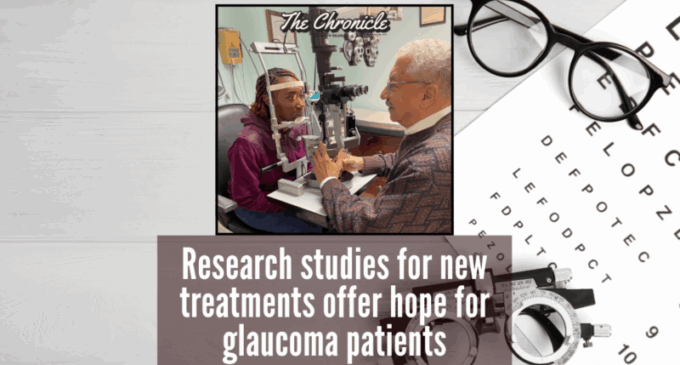
I was fortunate because my ophthalmologist, Dr. James D. Branch, has been doing research into eye diseases for over 40 years and is the only ophthalmologist between Charlotte and Durham conducting clinical trials.
Glaucoma cannot be prevented, but early detection and treatment can delay progression of the disease. Dr. Branch said that when he first began practice, there were just a few eye drops available to treat glaucoma. Now, thanks to ongoing research and clinical trials, there over 12 drugs as well as surgery to help manage the condition.
African Americans, Hispanics, diabetics, and those with a family history of glaucoma are at a higher risk for developing glaucoma. However, everyone over the age of 60 is at risk! Over three million Americans have glaucoma, but over half do not know it; it is the leading cause of blindness.
Dr. Branch said that glaucoma diagnoses are increasing because seniors today are becoming better educated about health issues and are more health conscious, resulting in more people being screened and receiving medical care. Clinical trials have increased the sophistication of eye drops, medication delivery vehicles, and surgeries. Some eye surgeries are now being performed in a doctor’s office that once were out-patient hospital procedures.
It is important to get regular exams with your eye doctor, who can note any changes in your eyes from year to year. Your doctor will perform a painless test to gauge the pressure in your eye and a field test to detect any loss of vision. A scan of your eye may be performed to measure the structure of the optical nerve, as well as a photograph of your eye to view the optical nerve which affects depth perception. All these tests are painless and covered under most insurance plans.
Dr. Branch said that new clinical trials are now focusing on delivery vehicles. One such trial that Dr. Branch conducted and is now FDA approved is the placement of a tiny insert into the eye that provides sustained release of medication for 13-18 months. Some ophthalmologists offer this as an in-office procedure while others perform it as an out-patient procedure. This treatment offers a more efficient delivery system and will aid in the care of glaucoma patients who have Parkinson’s, dementia, or disabilities that make it difficult to use eye drops every day.
“Up to 65% of patients are poorly compliant,” said Dr. Branch, meaning that they do not take their medications as directed on a regular basis. “Taking medication as directed, the physician can evaluate how the medication is working or if it needs to be changed.” Some of the reasons people do use their eye drops as prescribed is remembering when they should be taken (morning, during the day, at bedtime), having the dexterity to squeeze the small eye drop bottles, not wanting to carry eye drops during the day or while traveling, and expensive co-pays, so they try to stretch out their medications.
Dr. Branch said the newest studies for glaucoma are focused on the delivery systems because it is a way to know that patients are being compliant in taking their medications. “Such as an insert that we put in the fluid space behind the cornea and in front of the iris dissolves like a piece of hard candy over a period of six to 18 months, releasing medication 24 hours a day.” He is currently conducting studies on glaucoma medications. “We’re studying an insert by Duresta made by Allergan Pharma to see how the changes in dosage control eye pressure and how long they last. Another study is testing if it is inserted in front of the iris or behind the iris, to see if it makes a difference in control. This study is designed for people who have had cataract surgery with a lens implant.”
The studies Dr. Branch is conducting are at a final stage before FDA approval. He is currently enrolling for these studies. These treatments can be life-changing for people with glaucoma to not have to put eye drops in every day.
“Glaucoma is a serious disease that if undiagnosed and untreated, can rob you of your independence,” said Dr. Branch.
For more information on clinical trials for glaucoma treatment, contact the office of Dr. James D. Branch at 336-723-0748.