





Teaching our children the love of books opens their minds and imagination
David Winship reads to Head Start children in Abingdon, Virginia.
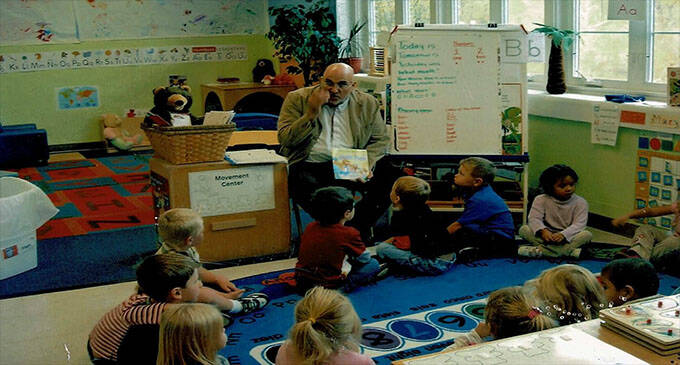
A retired school librarian talks about the importance of teaching children to love reading
By David Winship
Public schools are for public benefit, something we should all keep firmly in mind. That’s one of the main reasons I followed my family’s tradition and spent my career in them. My great-grandfather was one of the early encouragers of the National Education Association, my grandfather was a librarian at Harvard, and my father was a college English professor.
I started at Patrick Henry High School in Washington County, Virginia, in 1982, hoping to share my knowledge and interests and positively impact young minds. I spent the next 30 years working in libraries in both high and elementary schools, and I delighted in sharing books and my enjoyment of reading with students.
Literacy Stimulates the Imagination to Explore
Literacy is the source of exploration that nurtures people in their younger years and into the decades beyond. To help develop well-rounded citizens, we must encourage both the joy of reading and the joy in reading. Joy of reading can help us explore those realms with which we have less knowledge, but more curiosity. Joyful reading explores avenues, helping to establish empathy, our greatest strength.
The beauty of imagination is discovered in story, and its sharing goes on between author and reader. Imagination is important because this is where dreams develop. Dreams and imagination can be how we share others’ lives – those we have met, those we have not yet met, and those we may never meet. Imagination and dreams, with attention and effort, bring focus to possibilities that become realities,
In my years in schools, libraries and media centers have changed immensely, including being influenced by business management approaches such as Accelerated Reader (AR). Let me say at the outset that I’m not an AR fan. I believe it changed both what and how students read. It also monetized the process by emphasizing reaching reading goals and fueling competition in order to do so. But reading is more than an accumulated score to meet an arbitrary goal.
What we lost in the quest to gauge students’ reading levels, as opposed to their interest levels, was what is most important: learning an appreciation of the “art” of reading. This involves a child’s intrinsic interest in subjects, both non-fiction and fiction. What gets left behind is enjoyment, appreciation, and a love of reading. Too often the long-range benefits of education are sacrificed for immediate results, much like our culture in general.
From Books that Inspire to Imagination Station
Not long ago, I was invited to be a keynote speaker at the conference of the Virginia Association of School Librarians – Clinch Region, and, as I prepared, I decided to share three authors and readers that have been influential in my life.
The first is Dr. Seuss and I started with “The Cat in the Hat.” Theodor Geisel, writing as Dr. Seuss, created this classic book partly in response to a 1954 Life magazine article about literacy in early childhood. An editor at the publisher Houghton Mifflin asked Geisel to write a book using a limited vocabulary list suitable for early readers and to make reading fun for young children.
“The Cat in the Hat” has all the necessary elements of a good story – characters (narrator and Sally, Cat and Thing 1 and Thing 2, Mother), setting, plot (Mother’s away on a rainy day; what’s to do inside?), action, crisis and resolution. I always ask students, just as Dr. Seuss did, “What would you do?” Their responses are the engagement we want students to have with what they read.
The second is Dolly Parton and her Imagination Library. She’s probably done more for early-childhood reading than any author we have. Growing up without books in her home and recognizing their importance, she started the Imagination Library in her home county, Sevier County, Tennessee. In its 30 years, it’s made 287 million books available to youngsters from birth to age five in five countries. Imagination Library doesn’t pay for the books; it requires local support. Instead, it provides the infrastructure to choose and send the books to children signed up by their parents and guardians. Community support in many forms pays the cost of the books.
The first book is always “The Little Engine that Could,” Watty Piper’s children’s classic that Parton felt inspired readers to believe in themselves and to keep going. Teachers and school librarians have all benefited from the Imagination Library, with students arriving at school familiar with books and many parents becoming familiar with reading to their children. Communities that have Imagination Libraries are truly investing in their children and their generations.
A third author who has influenced me is Katherine Paterson, a family friend who is internationally recognized for her insightful and enjoyable books, including award-winners “Bridge to Terabithia” and “Gilly Hopkins.” Some of her work is rooted in her Chinese upbringing, which showcases an international flavor. Her Christmas books give a literary flavor to the season. Her broad range of influences, and how she shares her wisdom, have made her a hero to many in the education profession and readers of many persuasions.
Paterson is committed to helping youngsters learn to read, and I would like to mention one book in particular, “The Smallest Cow in the World.” A Vermont resident, she wrote it particularly for the migrant children who worked in nearby orchards and fields and didn’t have regular schooling or stories that were theirs. It became part of the Vermont Migrant Education Program and was later published in the “I Can Read” series by HarperCollins.
“The Smallest Cow in the World” is the story of young Marvin, who grew up as a child of migrant workers, and his relationship with Rosie, who was the meanest (and smallest) cow in the world at the time. It’s a simple story that relates and illuminates young childhood, but also resonates with the difficulties we all face when going through changes in our lives. Paterson has told some good tales, and she continues to do so at 92.
Books Continue to Enlighten me as an Older Adult
So where did that lead me as an adult reader? It led me to an awareness of others’ lives, of other ways of living, of how different life experiences influence the ways we grow. It exposed me to an understanding of others. Stories are both non-fiction and fiction, and the fiction ones are the ones drawn from real-life experiences. I write and read poetry. Some of the most dynamic and impactful poets I read are Black poets where I get a sense of their lives, bringing not only understanding but pleasure. Certainly, Nikki Giovanni and Maya Angelou have impacted me. Currently, Frank X. Walker, who pioneered the genre of Affrilachian poetry to combine and expresses his heritage and outlook of Blacks in Appalachia, has greatly influenced my understanding of those with whom I live in this world.
I read mostly non-fiction. During the sesquicentennial of the Civil War, I worked within the education community to highlight the variety of histories told with a Black emphasis. This is certainly American history, simply not whitewashed history. One of the authors whose writings were revelatory to me was Betty DeRamus, whose books “Freedom by Any Means” and “Forbidden Fruit,” brought to my attention and near understanding of that period of 19th century America whose influences last today.
Cultivating the Love of Books and Joy of Reading
So, how do we help make sure more people become avid readers, and how can we best help our children learn to love reading as we move forward? First, I think we continue to advocate for our students, and the children of our communities, having access to a wide and varied range of books.
We have to educate our public that education takes time – a lifetime. Education follows neither a factory model nor a business model. It is not a “one size fits all” and it is not a short-term, bottom line justifiable quantity. The more appropriate model for education comes from our natural system of growth.
Folks who grow things – farmers and gardeners – know that nothing grows immediately. Seeds planted need to be tended and nurtured. They go through growing and dormant seasons to bloom, flourish and produce. Learning is a similar cycle. We learn to read books, along with viewing a multitude of other media, to educate our minds and our imaginations. We need to nurture, interact and discuss what we read and encounter to understand it.
I worry that adults leave too much to chance when we fail to engage children in what they read and view, in what they learn and how they know.
David Winship is a retired educator who lives in Bristol, Tennessee. He directs the Sign of the George Letterpress at King University and continues to be involved with Washington County Schools, as well as with the Birthplace of Country Music Museum. He is an avid reader and is a member of Winston-Salem Writers.