
Staff Report
The Winston-Salem Chronicle
As hedge fund-backed publisher Lee Enterprises moves to stabilize its finances through a $50 million equity infusion and leadership transition, the ripple effects are likely to be felt far beyond corporate boardrooms—reaching newsrooms across the Triad, in Winston-Salem and Greensboro.
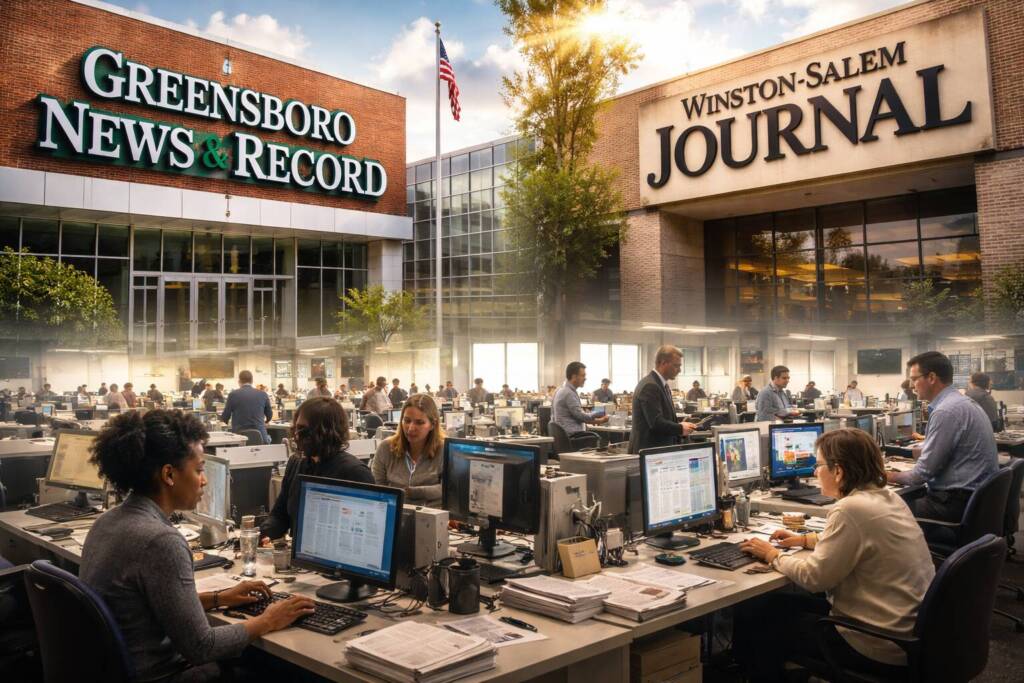
Lee owns both the Winston-Salem Journal and the Greensboro News & Record, the region’s two largest daily newspapers. Together, they shape much of the area’s mainstream news ecosystem. The company’s December 30 announcement outlines a strategy focused on debt relief, governance changes, and “disciplined execution,” but offers little direct assurance about local staffing, coverage depth, or community accountability.
What Changed — and Why It Matters
Under the agreement, Lee will reduce interest payments on roughly $455 million in long-term debt, cutting rates from 9% to 5% for five years. That relief comes at a cost: increased influence from investor David Hoffmann, who is expected to become board chair, and a board-led transition following the retirement of long-time CEO Kevin Mowbray.
For Wall Street, the move signals stability. For Triad residents, the implications are more complicated.
Local journalists and media analysts say debt restructuring often brings short-term breathing room—but not necessarily reinvestment in local reporting. Historically, Lee and similar chains have used savings to service debt, fund digital transitions, or consolidate operations, rather than expand newsroom capacity.
Potential Impacts on the Triad’s Newsrooms
1. Continued Pressure on Staffing and Beats
Neither the filing nor Lee’s public statements commit to newsroom expansion. In recent years, both the Journal and News & Record have experienced staff reductions, with fewer reporters covering city hall, education, courts, and neighborhoods. Even with improved cash flow, there is no guarantee those positions return.
For communities of color and working-class neighborhoods—already undercovered—this often means fewer stories told and less scrutiny of public institutions.
2. Greater Centralization of Decision-Making
The board-led transition and increased investor oversight could further distance editorial decisions from local communities. Corporate priorities—digital subscriptions, regional hubs, cost efficiency—may outweigh place-based journalism rooted in Winston-Salem and Greensboro’s distinct histories.
That centralization can weaken watchdog reporting, particularly on local government, law enforcement, school systems, and development deals.
3. Digital Paywalls and Access Gaps
Lee continues to emphasize subscription growth. While digital models are necessary, heavier paywalls risk limiting access for lower-income residents, seniors, and rural readers—groups already facing information barriers. In majority-Black and working-class neighborhoods, reduced access can translate into reduced civic participation.
Why This Matters Now
The Triad is navigating major transitions—population growth, school funding debates, hospital access challenges, and redevelopment pressures in historically Black neighborhoods. Robust local journalism is not a luxury; it is infrastructure.
When newsrooms shrink or narrow their focus, residents lose a key tool for understanding how decisions are made and who benefits.
What to Watch Next
• CEO Selection: Whether Lee appoints a leader with experience in local journalism—or one focused primarily on financial engineering—will signal the company’s true priorities.
• Budget Allocations: Any reinvestment (or lack thereof) in Triad-based reporting positions will be telling.
• Community Engagement: Will local editorial boards, public forums, or partnerships be strengthened—or further reduced?
• Alternative Media Growth: Gaps left by legacy outlets may continue to be filled by nonprofit, minority-owned, and community-based publications across the region.
The Bottom Line
Lee Enterprises’ financial reset may stabilize its balance sheet, but stability does not automatically translate into stronger local journalism. For Winston-Salem and Greensboro residents, the key question remains unanswered: Will this change restore local accountability—or merely prolong a thinner version of it?
For communities long underserved by mainstream media, the answer will shape not just what gets covered, but whose voices are heard.