
By Algenon L. Cash
The Winston-Salem Chronicle
Since the beginning, food and beverage establishments have brought communities together. The nation’s founders sat around tavern tables discussing their vision for a new country called America.
In Winston-Salem and Greensboro, storefronts with blinking “open” signs remain a cornerstone of the local economy. They are places for first jobs, date nights and church lunches. They are where neighbors meet over coffee, where teenagers discover responsibility and where retirees find routine and community.
Lately, though, they have been quietly disappearing.
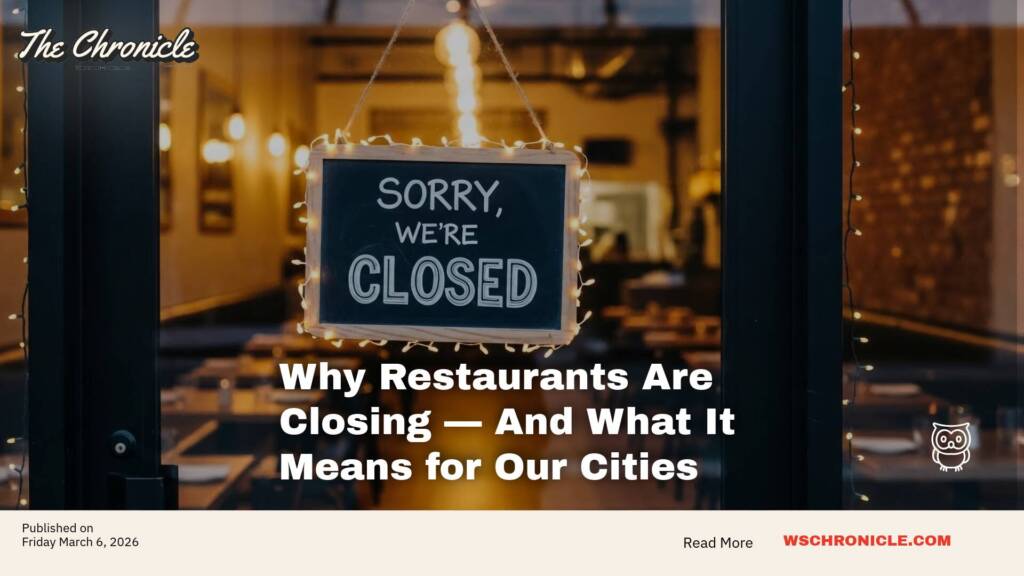
Legacy restaurants have been closing with little warning. In Winston-Salem, the loss of Sweet Potatoes and Sixth & Vine after more than two decades was more than another headline. It was a signal. Downtown staples like Mayberry’s shuttered after years as part of the city’s rhythm. Mojito Latin Soul closed its doors on Trade Street. And ROAR — one of the most visible entertainment-driven concepts in downtown Winston-Salem — is now for sale.
Greensboro has seen similar waves. Respected owners have chosen not to renew leases, not to reinvest and not to sign up for another cycle of uncertainty. The region was jolted when ’Cille & ’Scoe, Liberty Oak, Dame’s Chicken & Waffles and M’Coul’s Public House announced they would permanently close within weeks of each other.
This is not 2020.
During the COVID-19 pandemic, the shock was visible. Today’s shift is quieter — and in many ways more unsettling.
The economics have changed.
Rising property valuations are pushing up lease rates. Insurance costs have climbed sharply. Property taxes are increasingly passed through to tenants. Food costs have never fully returned to pre-pandemic levels. Labor costs are structurally higher. At the same time, consumers are dining out less frequently and more selectively, making home kitchens a growing competitor to brick-and-mortar restaurants.
Together, those pressures create a slow squeeze.
The owners I speak with are not careless operators. Many are seasoned professionals who survived recessions and shutdowns. But they are asking difficult questions:
Do I want to commit to another five or 10 years?
Will my family take over the business?
Is this how I want to keep spending my life?
For many, the answer is no — not because they are failing, but because the market reality has shifted.
Behind the scenes, more difficult conversations are underway. Rumors circulate about additional closures as owners grapple with the new environment. Some are quietly exploring sales. Others are reconsidering leases they once would have signed automatically. The uncertainty itself is becoming destabilizing.
I see this moment from multiple vantage points.
My career began flipping burgers at McDonald’s for $4.75 an hour. I bused tables at Olive Garden, washed dishes at Tripp’s, served at Ryan’s Steakhouse and bartended at Cherry Street Bar. Those kitchens and dining rooms shaped me.
Later, I served as chief financial officer of J&S Cafeteria, the sister concept to the legendary K&W Cafeteria. I have owned franchise locations including Hwy 55 Burgers Shakes & Fries and Skrimp Shack. I helped launch franchise concepts such as Calabash Seafood, Wicked Taco and Zesto. On the real estate side, I have sold buildings to restaurant operators such as Shinjuku and The One Korean BBQ in High Point.
Today, as an investment banker focused on commercial real estate, I help clients analyze leases, calculate valuations and structure capital. I understand what rising property values mean for landlords. I understand what insurance premiums mean for tenants. And I understand how even a small change in consumer behavior can erase already thin restaurant margins.
Restaurants remain one of the most important entry points into the workforce. They offer first jobs and second chances. They provide flexible schedules for students and young parents. They create a pathway from host to server to manager to owner.
When restaurants close, those pathways do not magically reappear elsewhere. They shrink. The ladder loses rungs.
Pressure is also emerging beyond the kitchen. As alcohol consumption declines and drinking habits evolve, breweries, distilleries and cocktail bars are experiencing contracting demand. Fewer nights out. Earlier evenings. Smaller tabs. The entire hospitality ecosystem faces a perfect storm.
This wave feels different because it is structural.
It is not one mismanaged business or one unpopular menu. It is capital costs, labor, food pricing, insurance, consumer fatigue and valuation pressure — all converging at once.
The deeper question is not simply why one restaurant closed. It is whether we are creating an environment where independent, locally owned restaurants can survive long term.
Are we honest about what it costs to run a thin-margin business today? Are property taxes, insurance premiums, public safety efforts and downtown revitalization plans aligned to support the people signing these leases? Or are we simply expecting resilience from owners without reinforcing the system around them?
Grit alone cannot overcome math.
If we are not intentional, these closures will not remain episodic. They will become the norm.
For many of us, our lives started in these kitchens. Mine did. A fryer and a clamshell grill were not just equipment — they were the beginning of a career. Those beginnings matter.
If we care about the Piedmont Triad, we should treat this moment with seriousness and clarity before a quiet contraction becomes permanent.
Algenon Cash is managing director of Wharton Gladden & Co., an investment banking firm. He can be reached at alc@whartongladden.com.