
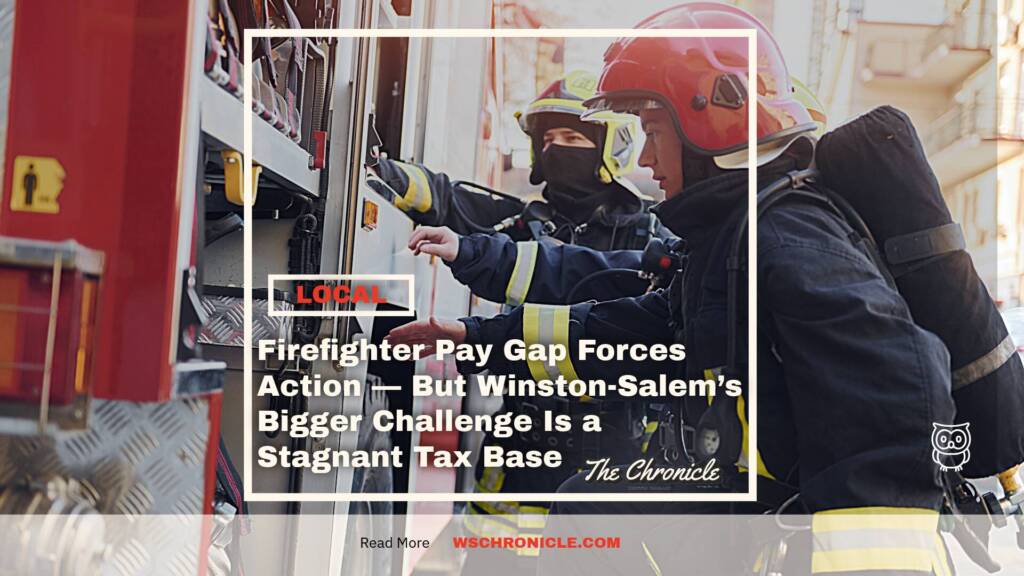
A new survey shows Winston-Salem firefighters earn less than those in peer cities, and now City Council is considering raises — along with a possible property tax increase — to address the gap.
This debate did not appear out of nowhere.
Last year, I wrote about the city’s decision to slash firefighter benefits and argued that the real issue was not firefighters. The deeper problem was leadership and long-term planning. When a city weakens compensation structures for public safety professionals, the consequences are predictable. Recruitment becomes harder. Retention suffers. Morale declines. Eventually, the problem resurfaces — usually requiring more expensive solutions.
Public safety professionals deserve competitive pay. That point should not be controversial. Every day, they choose to put themselves in harm’s way to protect our homes and our community. Making sure the fire department is well staffed and properly supported is one of the most basic responsibilities of local government.
Raising firefighter pay is a no-brainer, but the solution now being proposed — raising property taxes — deserves thoughtful consideration, especially given the broader financial pressures emerging.
Many residents and business owners are already dealing with significantly higher tax bills after the most recent property tax revaluations. Those unexpected increases arrived as homeowners are also managing rising utility costs and stubbornly high food prices. For business owners, these higher tax bills are arriving at the same time as rapidly increasing insurance premiums, while landlords look to adjust lease rates higher.
Winston-Salem is facing a deeper challenge than simply how to make firefighter pay more competitive. The question, moreover, is how the city can boost revenue to support essential public services without repeatedly asking the same residents and businesses to shoulder higher taxes.
If City Council raises tax rates to fund the pay raises, then it is only a short-term fix. New investment, healthy businesses and more high-paying jobs would be a far more sustainable solution. The tax base strengthens when a city becomes attractive to corporate headquarters, major employers and large-scale development. Cities leverage that kind of economic growth to fund critical public services while keeping tax rates relatively stable.
Unfortunately, Winston-Salem has struggled in this area for much of the past decade.
The city never recovered from the departure of many corporate headquarters — Krispy Kreme, Wachovia and BB&T, now Truist. Each announcement dealt a major blow to the city’s economic center. Since then, Winston-Salem has not recruited a comparable corporate presence to replace that loss, and the effects have been felt throughout downtown.
Downtown still has energy. Walk along Fourth Street on a busy evening and you will see it at Oh’Calcutta. Weekend brunch at Young Cardinal is busy. People are out enjoying the city. But during the middle of the workday, the difference from a decade ago is hard to miss.
Office vacancy remains high. Foot traffic has stalled. Legacy restaurants and retail shops that once comfortably depended on an army of daytime workers have been forced to make difficult choices — reducing hours or permanently closing. Downtown Winston-Salem is a historical place, attractive and culturally vibrant in many respects, but its economic foundation is under growing pressure.
This matters not only for downtown residents and businesses, but also for the long-term fiscal health of the city as a whole.
High-density central business districts are the most efficient places for cities to grow their tax base. Infrastructure already exists. Public safety coverage is centralized. Utilities, roads and public services can serve a large concentration of businesses and workers within a relatively small geographic area. When cities successfully attract corporate investment into these districts, the return to the tax base can be substantial. Winston-Salem leaders are fully aware they should be aggressively pursuing this kind of growth, but the city routinely finds itself debating reactionary solutions to deal with budget pressures tied, in part, to a stagnant tax base.
This is why the firefighter pay raises are about far more than compensation plans. It is about leadership.
A well-managed city plans years ahead. It anticipates workforce needs. It maintains competitive compensation for public safety professionals. It invests in economic development strategies that attract new employers and expand the tax base. Most importantly, elected leaders communicate clearly with residents about long-term priorities.
The question Winston-Salem should be asking right now is not just whether firefighters deserve raises.
The real question is: how did the city allow itself to fall behind in the first place?
Algenon Cash is a nationally recognized speaker and the managing director of Wharton Gladden & Company, an investment banking firm. He can be reached at alc@whartongladden.com.
Editor’s Note: According to information presented to the Winston-Salem City Council in 2025 by the city manager, changes to firefighter overtime pay resulted from administrative actions implemented without council approval under previous city manager leadership.