






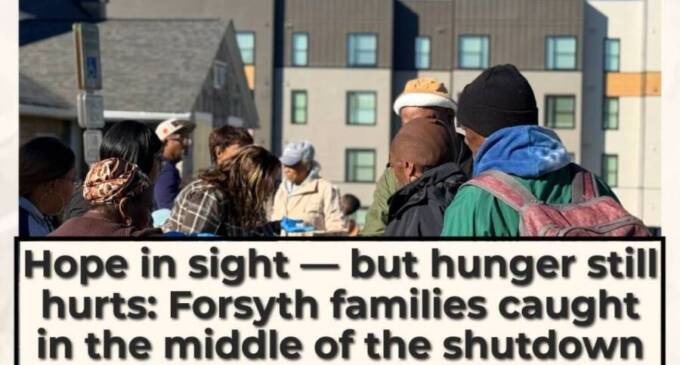
Hope in sight — but hunger still hurts: Forsyth families caught in the middle of the shutdown
By The Winston-Salem Chronicle
WINSTON-SALEM, N.C. (Nov. 11, 2025) — After weeks of uncertainty that left thousands of Forsyth County families wondering how they would afford their next meal, there is finally a glimmer of hope that relief may be near.
On Monday night, the U.S. Senate passed a stopgap funding bill to reopen the federal government and restore full operations to key programs, including the Supplemental Nutrition Assistance Program, or SNAP. The bill, which extends government funding through Jan. 30, 2026, now awaits final approval in the House of Representatives, where a vote could come as early as Wednesday. (Sources: Reuters, CBS News, GovExec, N.C. Department of Health and Human Services press releases.)
If approved, the bill would end the nation’s longest shutdown in recent memory — but for many in the Triad, the damage has already been done.
A month of not knowing
Across North Carolina, more than 586,000 households rely on SNAP benefits to put food on the table. Roughly 57,000 of those recipients live in Forsyth County, where food insecurity already affects nearly one in six residents and more than one in five children. (Sources: Feeding America; WFMY News 2.)
When the government shutdown froze or reduced payments earlier this month, families who depend on SNAP saw only partial benefits — about 65% of their normal allotment — loaded to their EBT cards. Some received as little as $16. State officials at NCDHHS said they were ready to process full benefits but were ordered by the U.S. Department of Agriculture to pause payments pending federal authorization. (Sources: NCDHHS news releases Nov. 7–8, 2025.)
That pause rippled through the community almost overnight. At Sunnyside Ministry in south Winston-Salem, Executive Director David Holcomb said the organization “ordered thousands of extra pounds of food in anticipation of what was coming.” Shelves that once held staples like rice, beans and pasta have been emptied and refilled multiple times over the past two weeks.
“We’ve seen families who have never asked for help before,” Holcomb said. “The hardest part isn’t just hunger — it’s the not knowing.” (Source: WXII-12 News, Nov. 2025.)
Food banks filling the gaps
The Second Harvest Food Bank of Northwest North Carolina, which serves Forsyth and 17 surrounding counties, reports that demand has more than doubled since the shutdown began. CEO Eric Aft called the situation “a reminder of how fragile the safety net really is.”
“Our volunteers and partners have stepped up heroically,” Aft said. “But we’re all hoping for stability soon. You can’t plan your grocery deliveries around congressional gridlock.” (Sources: WXII-12 News; North Carolina Health News.)
The double pressure: food and housing
For many low-income households, the crisis is about more than food. Nearly half of Forsyth County renters spend more than 30% of their income on housing, according to the N.C. Housing Coalition. When SNAP is delayed, it forces impossible choices: pay the rent or buy groceries.
“It’s not just a missed meal — it’s missed stability,” said a staff member at The Shalom Project, which saw one of its busiest food-distribution weeks in a decade. (Source: North Carolina Health News, Nov. 3, 2025.)
Hope on the horizon, lessons in the aftermath
If the House approves the Senate’s bill this week, funding for SNAP would be secured through September 2026, offering much-needed certainty after more than a month of anxiety. But even if the shutdown ends, advocates say the psychological toll will linger.
Local social workers said many clients expressed fear when they checked their EBT balances and found too little to feed their families. (Source: North Carolina Health News, Nov. 2025.)
“People will remember what it felt like to open their EBT app and see a balance they couldn’t feed their kids on,” one said. “That fear doesn’t go away just because the government reopens.”
“The hope is real,” said Aft of Second Harvest. “But so is the hunger. We’ve got to keep both in view.” (Sources: WXII-12 News; North Carolina Health News.)
How to help
– Donate food or funds: Second Harvest Food Bank of Northwest NC (secondharvestnwnc.org)
– Volunteer: Sunnyside Ministry, The Shalom Project, Samaritan Ministries and other local pantries are accepting volunteers and donations.
– Need assistance? Call Forsyth DSS at 336-703-3800 or visit epass.nc.gov to apply for SNAP or find emergency resources.
At a glance
– Senate passed shutdown bill Nov. 10 (60–40 vote)
– House expected to vote mid-week; if passed, funding extends to Jan. 30, 2026
– SNAP funding secured through September 2026 under the proposal
– 57,000 Forsyth County residents rely on SNAP; 16.6% are food insecure
– Second Harvest and local pantries report doubled demand since the shutdown began
Editor’s note
This story reflects conditions and reporting available as of Tuesday, Nov. 11, 2025, during the ongoing federal government shutdown. The U.S. Senate had passed a temporary funding measure to reopen the government, but the House of Representatives had not yet voted at press time.
If the House passes the bill, federal programs such as SNAP will resume full operations. The Winston-Salem Chronicle will update this article as new information becomes available.