






In Forsyth’s At-Large Race, Schools, Trust, and Two Very Different Theories of Leadership
By A. J. Daniel
The Winston-Salem Chronicle
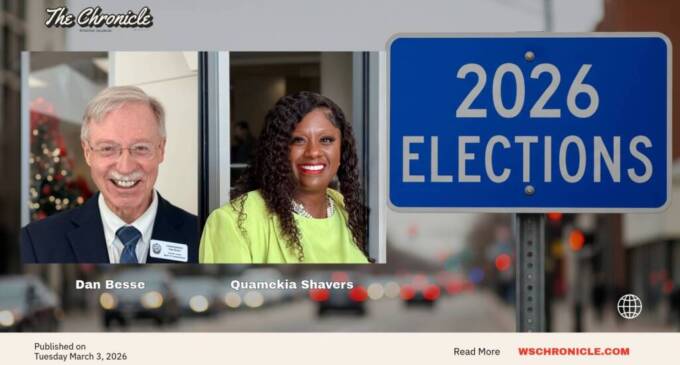
When the midterm elections filing period opened in December 2025, the early tremor in Forsyth politics came quickly: the County Commissioner At-Large race was officially contested. Incumbent Dan Besse filed for a second term. Minutes later, Quamekia (Que) Shavers, a community organizer and political strategist, stepped forward to challenge him.
Two candidates. One countywide seat. And a community still processing a public school system that slid into fiscal crisis on the county’s watch.
The at-large race is always a referendum on public trust. This year, trust isn’t just a theme — it is the entire backdrop.
Besse: “Support and oversight — but legally distinct”
When asked how the commission should respond to the school system’s breakdown in fiscal controls, Besse first drew a clear legal boundary.
“Legally, we don’t have a direct role in the oversight.”
He followed with an acknowledgment that public expectations have shifted.
“We’ll have to be keeping a closer watch at the money they get from us… to ensure better budget and fiscal controls are put into place.”
The message is one of continuity: a steady hand, long institutional memory, and incremental repair.
Besse pointed to what he views as key accomplishments during the crisis:
- Helping eliminate the district’s debt to the state
- Mobilizing private and philanthropic partners to stabilize the system
- Delivering a record $180 million county appropriation for public schools
Those are measurable outcomes. They also coexist with lingering frustration from families and educators who believe warning signs surfaced too late. In a year of shaken confidence, the experience Besse emphasizes may also be the experience some voters scrutinize.
Besse acknowledged equity as a continuing fault line.
“Our Black and brown communities have gotten the short end far too many times… I want to continue to work to change that.”
His case to voters is continuity with purpose.
Shavers: “Judge me by my work ethic, not my opponent”
Where Besse leaned on institutional experience, Quamekia (Que) Shavers offered a contrasting ethic: movement energy, personal discipline, and community-centered leadership.
Shavers is known less as a candidate and more as the strategist behind candidates — a campaign manager and civic organizer stepping into the race herself.
Her opening message was direct.
“I am asking the community to judge me based on my work ethic and my community involvement… I am hoping for an opportunity to do something different in hopes that it will yield a positive change.”
Rather than centering her campaign on opposition to the incumbent, Shavers rejected that framing.
“When you are running, you’re not running against anyone but yourself.”
“How I differentiate myself… is how I get up and work every day.”
She described a leadership philosophy grounded in daily accountability:
- Did I work harder today than yesterday?
- How am I involving the community?
- How am I educating the community?
- How am I empowering people within the democratic process?
It is the language of someone accustomed to mobilizing voters rather than governing institutions — a distinction that may resonate in a year when many residents feel excluded from decision-making.
Shavers’ campaign represents not only a challenge to an incumbent, but a philosophical contrast: institutional experience versus movement-driven accountability.
Two lanes, one question: Who holds power accountable?
The at-large seat is not tied to a district; it represents every voter in Forsyth County. As a result, it is uniquely sensitive to public sentiment across:
- Suburban parents frustrated by the school finance collapse
- Rural communities watching services thin out
- Urban Black and brown neighborhoods long underserved by school facility investment
- Residents weary of opaque decision-making
Both candidates speak about community — but they define it differently.
Besse frames community through continuity and institutional stewardship.
Shavers frames community as a participatory engine that must be reactivated.
They are presenting contrasting political identities: one rooted in public office, the other in public mobilization.
Besse’s long tenure — first on the Winston-Salem City Council and now on the county commission — gives him a built-in advantage in a countywide race where name recognition and incumbency often determine margins. But Shavers’ community-rooted profile, combined with growing dissatisfaction toward county and school governance, gives her a credible opening, particularly in an election cycle where school board races will likely shape voter sentiment. Should voters signal a desire for change at the school board level, county commissioners — incumbents included — could find themselves absorbing political consequences tied to institutional failures they did not directly manage but remain connected to.
What this race signals moving forward
Forsyth County’s current political season has been shaped by institutional failure, generational inequity, and a public newly aware of how little oversight it has received.
The Besse–Shavers contest is not just about a seat.
It is about what kind of leadership demands accountability in a county where the cost of silence has become clear.
This race is a test of whether trust can be rebuilt — and by whom.