
Staff Report
The Winston-Salem Chronicle
Winston-Salem drivers are feeling the first signs of a global conflict at the pump, as gasoline prices across the Triad climb sharply following disruptions to one of the world’s most important oil shipping lanes.
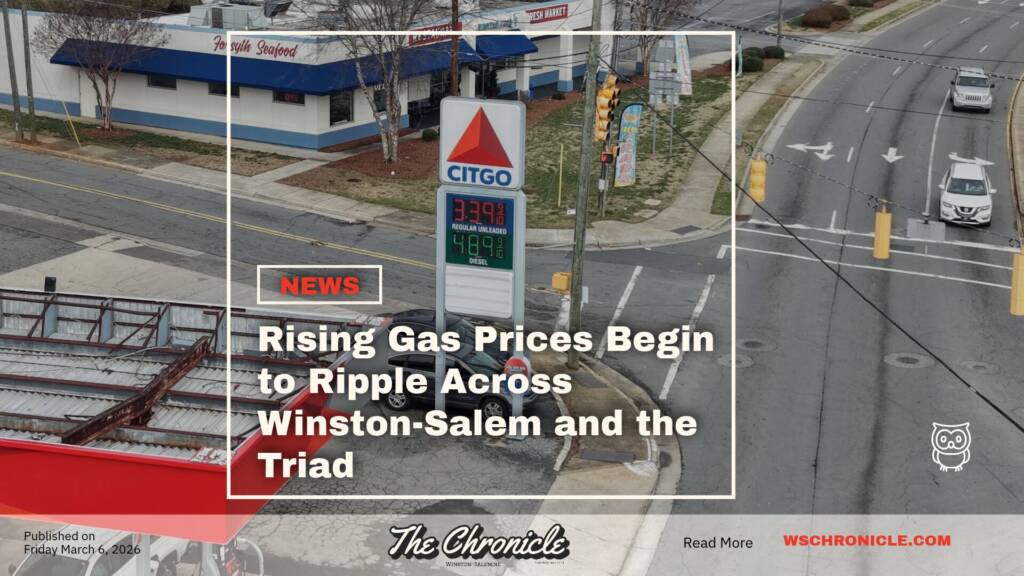
Over the past two weeks, average gasoline prices in North Carolina have jumped sharply, pushing many stations in Winston-Salem above $3 per gallon, with the statewide average now around $3.27 per gallon, according to AAA data and regional fuel tracking reports.
The increase follows escalating tensions and military strikes involving Iran in late February that disrupted tanker traffic through the Strait of Hormuz, a narrow waterway between Iran and Oman that carries about one-fifth of the world’s oil supply.
Energy analysts say the ripple effects from that disruption are already moving through local economies like Winston-Salem’s — first through gas stations, and soon through trucking, groceries, and everyday household costs.
Local Drivers Feel the First Impact
For many Triad residents, the change has been noticeable almost overnight.
Just a week earlier, the average gasoline price in North Carolina was about 50 cents lower, meaning the recent jump represents one of the fastest weekly increases in recent years.
Earlier this month, Winston-Salem gas prices were averaging around $2.77 per gallon, roughly in line with the statewide average at the time.
Now, with the state average sitting around $3.27, many local stations are posting prices between $3.15 and $3.35, depending on neighborhood and station brand.
For families commuting across the city — whether from East Winston to downtown, Kernersville to Wake Forest University, or across Forsyth County for work — the increase quickly adds up.
A commuter filling a typical 15-gallon tank is now paying roughly $7 to $8 more per fill-up compared with just a week ago, and significantly more than earlier this winter.
For households already navigating rising rent, grocery costs and utility bills, even modest fuel increases can strain monthly budgets.
Why a Conflict Overseas Affects Winston-Salem
The connection between Middle East conflict and Triad gas prices may seem distant, but the global oil market ties them closely together.
The Strait of Hormuz is considered one of the world’s most critical energy chokepoints. Roughly 20 million barrels of oil pass through it daily, supplying major economies across Asia, Europe and the United States.
When conflict threatens that shipping route, oil markets react quickly.
Global crude prices have surged above $100 per barrel in recent days after climbing rapidly since the strikes in late February.
When crude prices rise, the wholesale price of gasoline — what stations pay before selling to drivers — usually follows within days.
Energy analysts often estimate that every $10 increase in crude oil adds roughly 20 to 25 cents per gallon at the pump.
Diesel Spike Could Hit Local Businesses Next
While gasoline prices are climbing, diesel fuel — the backbone of the freight economy — has risen even faster.
National diesel prices are now averaging about $4.66 per gallon, raising concerns across industries that rely on transportation and shipping.
That matters for Winston-Salem’s economy because diesel fuels:
- Tractor-trailers delivering groceries and consumer goods
- Construction equipment and building projects
- School buses and public transit vehicles
- Agricultural machinery in surrounding counties
Local trucking companies and contractors are often among the first businesses to absorb the impact.
If higher diesel prices persist, analysts say residents could see secondary effects on grocery prices, shipping costs and construction projects throughout the Triad.
A Familiar Energy Shock — With Modern Differences
While the Strait of Hormuz has been a flashpoint before, sustained disruptions of this scale are rare.
Iran has threatened to block the waterway several times over the past several decades, including during tensions in 2012 and 2019, but those incidents produced only short-lived price spikes.
Historically, the closest parallel was the “Tanker War” of the 1980s, when attacks on oil ships during the Iran-Iraq War reduced Gulf shipping and drove up energy costs worldwide.
Today’s global economy is somewhat more resilient. The United States produces significantly more oil and natural gas domestically than it did decades ago.
Still, oil is priced globally, meaning American consumers — including those in Winston-Salem — remain vulnerable to supply disruptions anywhere in the world.
What Happens Next
Energy economists say the future of gas prices will depend largely on how long tanker traffic remains disrupted in the Persian Gulf.
If shipping resumes quickly, prices could stabilize or decline within several weeks.
If disruptions continue, analysts warn national gasoline prices could move toward $3.50 per gallon or higher in the near term, with some projections warning prices could climb significantly further if the conflict drags on.
For Winston-Salem residents, the immediate concern is simpler: the rising cost of everyday travel.
Whether commuting across Forsyth County, driving children to school activities, or running errands across the city, the price displayed on gas station signs is becoming a visible reminder that events thousands of miles away can reach directly into the household budgets of local families.